By: Nigel Bankes
Matters Commented On: (1) Annual Report of the Permanent Engineering Board (PEB) to the Governments of the United States and Canada under the terms of the Columbia River Treaty for the period of October 1, 2023 – September 30, 2024, May 16, 2025, and (2) Flood Risk Operating Plan (FROP) for the Columbia River Treaty, June 26, 2025
PDF Version: Continuing Implementation of Revisions to the Columbia River Treaty
The Columbia River Treaty (CRT) entered into force in September 1964. While the CRT has no expiry date, certain terms of the CRT, specifically the flood control provisions of the treaty, were scheduled to change automatically on the treaty’s sixtieth anniversary (September 16, 2024) in a way that would provide the United States far less certainty as to future upstream flood control operations in Canada. For this, and a number of other reasons, the US and Canada were motivated to modernize the CRT and to that end, and as highlighted in previous posts on ABlawg, the governments of Canada and the United States entered into a non-binding agreement in principle (AiP) in July 2024 outlining proposed changes to the Columbia River Treaty (CRT) (see posts on the AiP here and here).
Canada and the US subsequently implemented some, but certainly not all, of the elements of the AiP through a series of Entity Agreements and Exchanges of Diplomatic Notes (EoNs) in the fall of 2024. The term Entity Agreements refers to agreements between the operating entities of the main storage and generating facilities on both sides of the border: BC Hydro (BCH) in Canada and the Bonneville Power Administration (BPA) and the US Army Corps of Engineers (US ACE) in the US (hereafter the “Entities”). As detailed in a previous post, Interim Arrangements to Implement the Agreement-in-Principle, these interim arrangements focused on the flood control (or flood risk management (FRM) as it is now known), transmission, and the downstream power benefits provisions of the AiP. Other elements of the AiP have effectively been deferred including the so-called enhanced flexibility provisions related to the operation of Canadian storage, and the proposed Joint Ecosystem and Indigenous and Tribal Cultural Values Body (JEB). I have previously argued that this prioritization favoured the traditional treaty values (power and flood) and the economic issues of most interest to the United States at the expense of ecosystem values and Canadian priorities. See link to “Interim Arrangements” post, above.
This current post focuses on two additional developments and related documents relevant to the interim arrangements. They are: (1) the Annual Report of the Permanent Engineering Board (PEB) to the Governments of the United States and Canada under the terms of the Columbia River Treaty for the period of October 1, 2023 – September 30, 2024, May 16, 2025, and (2) the new Flood Risk Operating Plan (FROP) for the Columbia River Treaty, June 26, 2025.
Part 1: The Annual Report of the PEB
Established by the CRT when it first entered into force in 1964, the Permanent Engineering Board (PEB) is the principal institutional innovation of the treaty (the Entities themselves have established other institutions, including the Entity operating committee and a hydrometeorological committee). Article XV of the CRT describes the responsibilities of the PEB as follows:
ARTICLE XV
Permanent Engineering Board
- A permanent Engineering Board is established consisting of four members, two to be appointed by Canada and two by the United States of America. The initial appointments shall be made within three months of the ratification date.
- The Permanent Engineering Board shall:
(a) assemble records of the flows of the Columbia River and the Kootenay River at the Canada-United States of America boundary;
(b) report to Canada and the United States of America whenever there is substantial deviation from the hydroelectric and flood control operating plans and if appropriate include in the report recommendations for remedial action and compensatory adjustments;
(c) assist in reconciling differences concerning technical or operational matters that may arise between the entities;
(d) make periodic inspections and require reports as necessary from the entities with a view to ensuring that the objectives of the Treaty are being met;
(e) make reports to Canada and the United States of America at least once a year of the results being achieved under the Treaty and make special reports concerning any matter which it considers should be brought to their attention;
(f) investigate and report with respect to any other matter coming within the scope of the Treaty at the request of either Canada or the United States of America.
- Reports of the Permanent Engineering Board made in the course of the performance of its functions under this Article shall be prima facie evidence of the facts therein contained and shall be accepted unless rebutted by other evidence.
- The Permanent Engineering Board shall comply with directions, relating to its administration and procedures, agreed upon by Canada and the United States of America as evidenced by an exchange of notes.
As can be seen from this text, the PEB has six different functions: first, to assemble records of flows at the international boundary for each of the Kootenay and Columbia Rivers; second, to report to the parties on any substantial deviations from flood control and power operating plans; third, to assist in reconciling differences between the entities; fourth, to make inspections and require the entities to report, so as to ensure “that the objectives of the Treaty are being met”; fifth to prepare annual reports to the parties on the results being achieved under the Treaty, and finally, to report on any other matter within the scope of the Treaty at the request of either party.
The 1964 Protocol to the CRT assigned certain additional responsibilities to the PEB with respect to a post-2024 called-upon flood control operation: Protocol, Article I. These provisions are now in effect. They stipulate that Canada’s flood control obligations post-2024 cannot require Canada to provide “any greater degree of flood control” post-2024 than that provided for the first sixty years of treaty operations, and further, that a call can only be made to the extent that the potential floods triggering the call could not be “adequately controlled by all the related storage facilities” in the US. The provisions go on to give the PEB some additional directions in the event that the US does initiate a call:
(3) …. Within ten days of receipt of a call, the Canadian entity will communicate its acceptance, or its rejection or proposals for modification of the call, together with supporting considerations. When the communication indicates rejection or modification of the call the United States entity will review the situation in the light of the communication and subsequent developments and will then withdraw or modify the call if practicable. In the absence of agreement on the call or its terms the United States entity will submit the matter to the Permanent Engineering Board provided for under Article XV of the Treaty for assistance as contemplated in Article XV(2)(c) of the Treaty. The entities will be guided by any instructions issued by the Permanent Engineering Board. If the Permanent Engineering Board does not issue instructions within ten days of receipt of a submission the United States entity may renew the call for any part or all of the storage covered in the original call and the Canadian entity shall forthwith honor the request.
This clause evidently builds upon Article XV(2)(c) of the treaty and invites the PEB to assist the Entities “in reconciling differences concerning technical or operational matters”. The PEB’s responsibilities are therefore technical in nature. The PEB’s mandate does not allow it to offer binding interpretations of treaty obligations.
Paragraph (4) of Article XV of the treaty makes it clear that the PEB is a subordinate body insofar as it must “comply with directions, relating to its administration and procedures, from the Parties (i.e. the US and Canada) “as evidenced by an exchange of notes.” The subordinate nature of the PEB is also revealed by the persons the two governments appoint to the Board: typically senior federal or provincial civil servants or former employees of BC Hydro on the Canadian side and US ACE personnel on the US side. In other words, the PEB is little more than an echo chamber for the Entities, lightly scolding themselves when necessary.
The principal written public product of the PEB is a series of annual reports of the PEB to the two governments in accordance with paragraph (e) of Article XV(2). Each report covers what is known as the annual “water year”: October 1 through to September 30 (WY), by contrast with the operating year (OY) for reservoir system planning, August 1 – July 30. These reports are archived on the US ACE website here. Most, if not all, of the other work of the PEB, including its work on reconciling differences between the Entities, is treated as confidential, except to the extent that the results of any such efforts might be reported in the annual reports. Until this last year, PEB reports built on another set of annual reports, namely the joint annual reports of the Entities to the PEB, which presumably can be treated as the reports required of the Entities by the PEB under Article XV(2)(d) of the treaty. The PEB reports generally summarized or reproduced much of the contents of the reports of the Entities and were of much the same length. This set of reports is also available on the same page of the USACE webpage as the PEB Reports.
The PEB members signed off on the report of last year’s operating season (October 1, 2023 to September 30, 2024) on May 16, 2025. As in past years, the report is addressed to Canada’s federal Minister of Energy and Natural Resources and to the Secretary of State for the United States. Most of the events covered by this report fall under the original treaty regime that continued in force until September 16, 2024, the sixtieth anniversary of the treaty’s entry into force. The last 14 days of this reporting period fall under the treaty regime as varied by the expiry of assured flood control operation of the original treaty on September 16, 2024, and as further varied by the interim arrangements.
In the interest of providing some context for the treaty modernization negotiations, I note that, beginning with the 55th report for the 2018 – 2019 operating year, the PEB began to report that the Entities had not been able to agree on the terms of the Assured Operating Plan (AOP) for the 2025 – 2026 operating year as required by Annex A, s 9 of the CRT (this section imposes a duty to prepare an AOP six years in advance of the operating year). The covering letter for that report recorded that “The Entities are prioritizing work associated with the ongoing negotiations between Canada and the United States to modernize the Treaty, with the expectation that [the AOP] will be informed by the outcome of those negotiations.” Notwithstanding this deficiency, the PEB reported that it “is satisfied that the Treaty objectives have been achieved during this reporting period.” Recall that this evaluation is a key obligation of the PEB under Article XV(2)(d) of the treaty (quoted above).
Subsequent reports continued to draw attention to the Entities’ non-compliance with the Treaty obligation to establish AOPs six years in advance with increased urgency. For example, in the 56th report for 2019 – 2020, and then again in the 57th report for 2020 – 2021, the Board noted as follows:
The Board does wish to bring to your attention one significant and consequential issue of noncompliance. Under Annex B of the Treaty, the Entities are to determine downstream power benefits on the basis of an Assured Operating Plan (AOP), to be agreed between the Entities six years in advance of the operating year. At present, the Entities are late in the development of AOP 25 (operating year 01 August 2024 to 31 July 2025), AOP 26 (operating year 01 August 2025 to 31 July 2026) and AOP27 (operating year 01 August 2026 to 31 July 2027).
The development of these AOPs is dependent on the outcome of the Treaty negotiations that are ongoing between our two countries. With certain provisions of the Treaty expiring in 2024, and uncertainty in the outcome of the modernization negotiations, the Entities are working on those aspects of AOP25 that are expected to continue while remaining flexible to adapt AOP25 should modernization negotiations conclude. As a result, the completion of AOP25, AOP 26 and AOP27 has been delayed. Without an agreed to AOP, there is no guidance on the operation of the Canadian storage system with significant consequences in both Canada and the US for power generation, flood risk management and social and environmental objectives.
On 18 March 2022, the Board transmitted a letter to the Entities requesting a definitive timeline for AOP25 development along with regular (quarterly) reporting on the progress of that schedule. As we are now only 2.5 years away from the start of the 2024-2025 operating year, the Board once again seeks the support of both of your governments in seeing the Treaty negotiations completed to ensure that the Entities can complete the AOPs and avoid future operational challenges. (emphasis added)
And by the time of the 58th report of the PEB for 2021 – 2022 the Board was simply “deferring to the countries” on the resolution of outstanding AOP issues while still, amazingly enough, concluding that it was “satisfied that Treaty objectives were achieved”. It is hard to understand how the PEB could reach this conclusion while at the same time advising that “the Entities are not currently fulfilling the requirements of the Treaty as related to the AOPs and have not provided the Board with a mutually-agreeable path forward to come into compliance.” The Board had much the same things to say in its 59th report for 2022 – 2023.
Consistent with the cover letters accompanying the Board’s last three Annual Reports, the Board must once again bring to your attention a significant and consequential issue of non-compliance for coordinated Treaty operations and compensation beginning 1 August 2024.
Given this passive behaviour on the part of the PEB, I did not expect to see the self-congratulatory language introducing the current PEB Annual Report (for 2023 – 2024) asserting that the Board “plays a crucial role in overseeing and facilitating the implementation of the Treaty”.
I think that the PEB’s role is now more accurately described as that of simply reporting on what the Entities have (or have not) done in the reporting year. Notwithstanding its claim to perform a crucial role, the Board itself seems bent on confirming that its function is limited to a passive reporting function. The cover letter for this most recent report indicates that its role will become, if anything, yet more passive: “In an effort to streamline and increase efficiency in the process, this marks the first year that the Board is formally submitting the Entity Report as the official Report to the Governments.” Hence this year’s PEB report consists of a five-page cover letter signed by the PEB members with the report of the Entities as an attachment. This is little more than self-reporting by the Entities themselves on their own performance (or lack thereof).
And once again, the PEB continues to find itself “satisfied that Treaty objectives were achieved during this reporting period” notwithstanding the fact that, for the first time in the history of CRT, the Entities found themselves without an assured operating plan when the operating year began on August 1, 2023. That continued to be the case until the Entities signed a new AOP (AOP 25) on September 17, 2025 under the authority of an Exchange of Notes. (I discuss that EoN in my earlier post, Modernization of the Columbia River Treaty: Interim Arrangements – the EoN was required because the AoP “departs substantially from the immediately preceding assured plan of operation” as per Article IV of the CRT, but also because it effectively amends one of the core elements of the treaty, namely the determination of the downstream power benefits.)
While, as the above suggests, much of the Board’s cover letter simply summarizes the activities of the Entities during the operating year, three matters deserve emphasis. First, the PEB’s cover letter confirms that there is a very real sense in which the new arrangements for the downstream power benefits are far more than interim arrangements. In fact, the schedule of declining power benefits as agreed in the AiP will continue over the next 20 years unless replaced by new treaty text. Second, and related to this, the cover letter confirms that the Entities have agreed, and the EoN has confirmed, that if the Entities are unable to agree on an AOP for any forthcoming operating year, the existing AOP will simply continue. This means, as the PEB notes, that there will never be a scenario such as experienced this last year where there is no applicable AOP. Third, the Board confirms that while there was a period during the reporting year where there was no AOP, day-to-day operations continued much as before during that period. This must be seen as a positive outcome whatever one thinks about the substance of the interim arrangements, since it speaks to the long-standing cooperative and professional operating relationship between the Entities.
Conclusions
My review of the PEB Annual reports from the 2018 – 2019 report forward confirms that the US was setting itself up to demand a reduction of Canada’s downstream power benefits (DSB) come the CRT’s 60th anniversary, whatever the outcome of treaty modernization negotiations. Recall that while the CRT dealt expressly with a change to flood control operations in 2024, the treaty did not contemplate any change to the power operations or the methodology for calculating Canada’s downstream power benefits. Hence, the US needed leverage to ensure that the status quo for calculating the downstream power benefits did not remain in place after 2024. It realized that leverage by withholding Entity approval of new AOPs from 2018 onwards. That meant that it would be impossible for the Entities to calculate the DSB commencing with the 2024-2025 operating year.
It is hard to assess what role this pressure tactic played in the negotiations that led to the re-stated downstream power benefits contained in the AiP and included in the Exchange of Notes covering the next twenty years, but it must have been one of the factors that played into the negotiations as the clock advanced to September 2024. In the end, I suspect that the table of capacity and energy benefits in the AiP was a saw off as each side grappled with the uncertainties associated with the evolution of power markets and load projections in the Pacific Northwest as well as other factors influencing the calculation and value of the downstream benefits.
Table defining Canada’s downstream power benefits.
| Operating year | Capacity (MW) | Energy aMWh |
| 2025 -229 | 660 | 305 |
| 2030 | 590 | 278 |
| 2031 | 573 | 225 |
| 2032 | 565 | 225 |
| 2033 | 558 | 225 |
| 2034 – 2044 | 550 | 225 |
Source: AiP Public Document at 5.
And no doubt both sides appreciated that it was better to have the certainty of the table of benefits rather than the uncertainty surrounding what might happen in the absence of any agreement on the terms of successive AOPs. Perhaps Canada also decided that it was preferable to accept a compromise statement of the downstream benefits rather than referring the failure to adopt an AOP to the vagaries of formal dispute resolution under Article XVI of the CRT.
Part 2: From FCOP to FROP
Flood control was one of the two main objectives of the parties (the other being power generation) when the Treaty was first negotiated in the early 1960s. The basic objective of flood control is to operate available storage space to reduce flows to non-damaging levels and, where that is not achievable, to mitigate possible damage as much as possible. See FCOP – 223 at 9 and FROP at 2. Storage reservoirs are evacuated in accordance with storage reservation diagrams (for an example, see below) during the winter evacuation period, and then subject to controlled refill when unregulated flows are high, thereby reducing downstream flood flows.
On the flood control side of things, Canada’s initial treaty commitment was to dedicate 8.45 million acre feet (MAF) of treaty storage to flood control (CRT, Article IV(2) and Annex A at para 5). Most of this (7.1 MAF) was originally allocated to the Arrow Lakes reservoir behind the Keenleyside dam, but a series of Entity agreements (concluding in 1995) redistributed Canada’s assured flood control obligation as follows: Arrow, 3.6 MAF, Mica, 4.08 MAF and Duncan, 1.27 MAF (no change) for a total 8.95 MAF (BC Hydro agreed to increase total flood control space by 0.5 MAF in return for moving flood control space from Arrow upstream to Mica.) The details are discussed in the Flood Control Operating Plan (FCOP-2003) at 14, 24 – 26. This storage was subject to the assured flood control operation established by the treaty under the terms of successive Flood Control Operating Plans (most recently, FCOP – 2003) until 2024. But the assured flood control provisions of the treaty expired automatically in September 2024 along with FCOP-2003. See Entity Agreement on Pre-Planned FRM, at paragraph (d) of the Preamble.
While the treaty (Article IV(3)) continues to provide for what is termed a “called-upon” operation going forward beyond 2024, the called-upon operation offers far less certainty to the US than the assured operation that had been in place for the first 60 years of the treaty’s life. Accordingly,, the US was motivated to seek additional flood control (or flood risk management) certainty and the parties delivered on this in both the AiP and the interim arrangements with an agreement to provide 3.6 MAF of pre-planned storage space at Arrow in return for an annual payment to Canada of US $37.6 million for each year in which the US Entity elects the pre-planned operation. The interim arrangements are reflected in an Entity Agreement (November 14 & 15, 2024) and an Exchange of Notes between the Parties (November 18 and 22, 2024) as discussed in my earlier post.
In this part of the post, I address the following issues: (1) what does the FROP address (and not address), (2) what is the pre-planned operation for the Arrow Lakes reservoir, and (3) what are the principal differences between the FCOP and the FROP?
- What does the FROP address (and not address)?
The Entity Agreement on Pre-Planned Flood Risk Management Arrangements contemplated development of a Flood Risk Operating Plan to help operationalize the terms of the interim arrangements. The new FROP has now been adopted by both Entities. It applies solely to the 3.6 MAF pre-planned operation for the Arrow Lakes reservoir. As the FROP itself explains:
This FROP is distinct from and not related to Articles IV(3), VI(4), VI(5), XII of the Treaty and Articles 1, 2, and 5 of the Protocol and is “without prejudice” to the positions of the entities in relation to the aforementioned treaty provisions. (FROP at 2)
In order to contextualize these cryptic references, I add that Article IV(3) addresses the called-upon operation, and paragraphs (4) & (5) of Article VI deal with the compensation owed to Canada for a called-upon operation. Article XII of the treaty and Article 5 of the Protocol refer to the operation of Libby. Articles 2 and 3 of the Protocol also speak to elements of the called-upon operation and the preparation of flood control operating plans (discussed above in the context of the responsibilities of the PEB), while Article 2 specifically prescribes that in preparing plans and making calls “every effort will be made to minimize flood damage in both Canada and the United States of America.” The “without prejudice” language of the FROP must mean that each party is entitled to insist on its rights under the treaty and protocol, notwithstanding the silence of FROP-2025 on an issue.
One result of all of this is that we now have a gap in flood control (or flood risk) operating plans for post-2024 with the expiry of the FCOP-2003. The FCOP-2003 principally detailed the methodology for the assured operation, but it also contained some guidance for the pre-2024 supplementary on-call operation (see FCOP 2003 at 22, 39 – 42 and Appendix A – these provisions were never actually triggered). FCOP-2003 was even more laconic in relation to the post-2024 called-upon operation observing merely that: “The operation of Canadian storage if called upon, will be based on the same type of operation as established under this Flood Control Operating Plan.” (FCOP-2003 at 15)
The FROP provides detailed guidance for the new pre-planned operation but is completely silent with respect to operating guidance for the called-upon operation which applies not only to Arrow but to all Canadian storage capable of providing flood control protection. The parties acknowledged this challenge in the AiP and advised that they “have mutually determined to develop a process to enhance the understanding of each other’s positions regarding Called-Upon flood control.” (AiP, public document, at 2) So far as I am aware, this remains a gap.
The laser focus of the FROP on Arrow also has other consequences. For example, FCOP-2003 goes to great lengths to place treaty flood control space within the broader context of the US ACE’s system planning for the entire Columbia River and basin (see FCOP-2003 at pp 1 – 4, section III and Glossary) and includes flood risk operations for the three Canadian treaty dams and Kooteny Lake as well as a section on the operation of Libby (section IX). All of this context and content disappear in the FROP. For example, the FROP makes no reference to Libby whatsoever.
- The pre-planned operation for the Arrow Lakes Reservoir
The Arrow lakes reservoir contains 7.1 MAF of active storage between normal full reservoir elevation of 1444 feet and a minimum elevation of 1378 feet. BC Hydro’s licence for Arrow Lakes reservoir allows it to surcharge the reservoir an additional two feet (1446). thereby providing approximately 0.25 MAF of additional storage. (FROP at 6). Arrow has a maximum ramping rate (i.e. change in regulated outflows from the dam) of 15,000 cfs per day while paragraph 4 of Annex A of the Treaty prescribes minimum average weekly outflows for Arrow of 5,000 cfs.
As with the prior FCOPs, the FROP operation at Arrow during the evacuation period is based on forecasts of unregulated runoff at The Dalles, Oregon. The higher the forecast flows the greater the required drawdown of Arrow. This is illustrated by the Storage Reservation Diagram for the reservoir which was included in the Entity Agreement and appears as Chart 1 in the FROP and reproduced below. Hence, when US ACE forecasts unregulated runoff of 80 MAF (or greater) at the Dalles, BC Hydro is required to make the full 3.6 MAF of pre-planned space available at Arrow by the end of March. This is essentially the same as Chart 6 of the old FCOP, although that chart also contains the reminder that, in response to a call from US ACE (that is to say an on-call operation), Canada may be required to evacuate the entire 7.1 MAF of active space at Arrow for flood control. The rules for a call are detailed in s 10.5 of the FCOP-2003 and Article 1 of the Protocol. The omission of this reference in the FROP is consistent with both expiration of the on-call obligations of the original treaty and the recognition that the FROP does not address the called-upon operation at all, but is “without prejudice” to each party’s interpretation of the called-upon operation as described in the treaty.
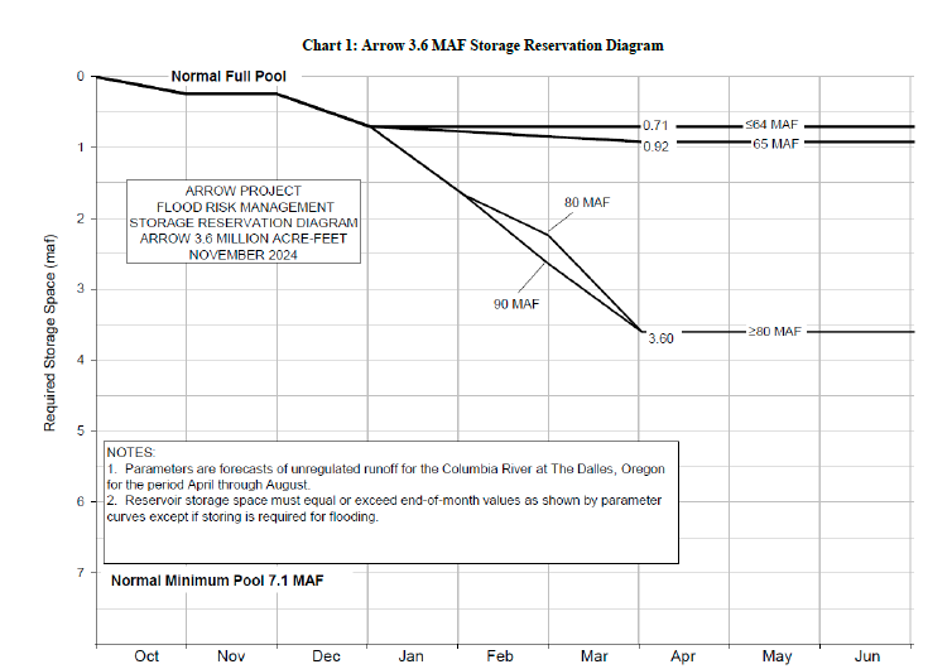
(Chart 1 from the FROP at 13.)
(The Chart depicts maximum elevation levels for Arrow by month depending upon total anticipated unregulated flows at The Dalles.)
The evacuation period is only part of the picture. Residents of the Arrow Lakes are also interested in the refill period and in particular how refill operations will be balanced between Lake Roosevelt (behind the Grand Coulee dam in the US), the Arrow Lakes reservoir and the Kinbasket reservoir (upstream of Arrow and impounded by the Mica treaty dam). All things being equal, the US has a strong incentive to preferentially refill Grand Coulee to provide additional head for the large generating capacity of that facility (installed capacity of 7,015 MW – by contrast Keenleyside has installed generating capacity of only 185 MW) while Arrow Lakes residents have a strong interest in having the Arrow Lakes reservoir return closer to full as soon as possible. The AiP addressed this issue by noting that refill operations would continue to be governed by the principle of proportional refill. (AiP at 2). While the AiP seemed to anticipate that this would be explained in greater detail in the FROP, in the end the FROP contains less guidance on proportional refill than did FCOP-2003. Here is what the FROP has to say:
A proportional split between Canada and the US mainstem Columbia River projects will be used as a guide to operations for the System FRM Fill Period requirements at Arrow, but the actual operations are highly dependent on the specific conditions in the year. (FROP at 9)
In sum, it looks to me as if the basic FROP operation for Arrow during the evacuation period will be much like the Arrow assured operation under the original treaty, while the rules on refill still seem to afford the US significant discretion as to how the principle of proportionate refill will be applied. As a result, the new rules are unlikely to be greeted with any enthusiasm by residents along the Arrow Lakes and those upstream as far as Revelstoke, as well those who use the Arrow reservoir for recreational purposes all of whom who have long expressed concerns about the deep drawdowns.
Finally, while the basic Arrow Lakes reservoir operation looks similar as between the FCOP-2003 and the FROP there are some subtle but potentially important differences between the two documents as noted in the next section.
- What are some of the other differences between the FCOP and the FROP?
I have already noted two principal differences between the FCOP and the FROP; the first being that the FROP, by its nature, focuses on Arrow and not on all three treaty dams, and second the FROP lacks the system-wide context and documentary history that informed the FCOP. While much of the structure of the two documents remains the same (e.g. there are separate sections dealing with the system evacuation period and the system refill period) there are additional differences. Here are some of those differences:
- The FCOP-2003 states that the purpose of the FCOP is to prescribe procedures for treaty facilities “to achieve desired flood control objectives in the United States and Canada.” (FCOP-2003 at 1 & 8). By contrast, the FROP indicates that the purpose of the 3.6 MAF operation is “to achieve FRM objectives in the United States.” (FROP at 1) Hence, while the FROP describes flood control objectives (FCOs) for each of Canada and the United States (FROP at 2 & 3) Canada’s FCOs occupy a subsidiary status in the FROP:
- “This FROP describes how “Canadian Local FRM” objectives are taken into account by the entities in relation to the operation of the 3.6 maf at Arrow to achieve FRM objectives in the United States.” (FROP at 3, emphasis added)
It is far from clear whether the parties and their Entities consider that this subsidiary function satisfies the treaty obligation to ensure that “every effort will be made to minimize flood damage” both in Canada and the US. (Protocol, Article 2)
A later section of the FROP (entitled “Canadian Local FRM”) makes the subsidiary nature of Canadian FCOs even clearer when it emphasises that “There is no pre-planned reservoir storage (0 maf) for Canadian Local FRM …”. The same section goes on to say that while there may be some operational flexibility to meet Canadian local FRM objectives “no part of System FRM space in Arrow will be reserved in advance specifically to achieve Canadian Local FRM objectives.” (FROP at 10 – 11) It is hard to square this dogmatic position with the “every effort” provision of the Protocol. At this point it seems germane to reference the views of the International Court of Justice with respect to the stringent nature of due diligence obligations (such as an “very effort” obligation) under international law: see my post on the ICJ’s Climate Chage Advisory Opinion here.
- While the FCOs for the United States remain essentially the same, the FCOs for Canada focus on the Columbia downstream of the Arrow Lakes Reservoir and have been somewhat re-stated, especially the FCO for Trail, British Columbia. Whereas the FCOP stated that damages commence at Trail with flows at 225 Kcfs (FCOP-2003 at 17), the FROP restates this as 180 Kcfs (FROP at 3). While this suggests a more aggressive target for managing flows, much may depend in practice on the potentially subsidiary nature of Canada’s FCOs. Furthermore, the FROP, as with FCOP-2003, continues to refer to “major damage” occurring at Trail when flows exceed 280 Kcfs even though other studies suggest that major damage will occur at significantly lower flows. The inclusion of two reference points (180 Kcfs and 280 Kcfs) also creates ambiguity as to what the actual FCO target is.
- The FCOP also included FCOs for the Kootenay/Kootenai rivers in both the US and Canada (FCOP-2003 at 17). Given that the FROP is confined to Arrow it is hardly surprising that this has been omitted but it begs the question of what is the current status of these FCOs? Is this another gap? The AiP addressed this as follows (but this is not reflected in the more formal and binding interim arrangements):
- Kootenay Lake Flood Risk
- The U.S. Army Corps of Engineers (USACE) is expected to continue to cooperate with Canada on requests for variation of Libby Dam’s operations, including providing a process for Canada that allows Canada to submit requests for in-season Libby operational variance alternatives to assist in meeting its flood risk objectives on Kootenay Lake.
- Such cooperation is intended to consider any recommendations of the Kootenay/Kootenai River Transboundary Collaborative Workgroup (KTCW, described below), once established, to incorporate Canadian flood risk concerns downstream of Libby Dam.
- Kootenay Lake flood damage elevation is important to both countries, as it provides a basis for planning considerations when managing Libby discharges to achieve the operating purposes of Libby Dam, including its fisheries operations.
- Canada and the United States have determined to work via appropriate mechanisms to identify flood-stage elevations at key locations in Kootenay Lake (Canada’s evaluations have shown damage can begin at 534 m (1,752 ft)) (AiP summary at 2).
- The FROP also introduces an additional element to the FCOs with the concept of a “system flood emergency” (SFE). The US ACE may declare an SFE when the US ACE forecasts flood levels at Vancouver, Washington of 16 feet (this is one of the key US FCOs) (FROP at 2 and 5). An SFE triggers “increased communication and coordinated project operations and triggers specific operational requirements”. In particular, an SFE may be made as part of response to fall or winter flooding conditions caused by atmospheric river storms. This in turn may trigger a set of much more detailed obligations for reducing Arrow outflows during both the system evacuation period, and even more prescriptive provisions during the system refill period (outflows as low as 5,000 cfs may be prescribed).” (FROP at 10)
These provisions are far more prescriptive than those found in the FCOP and go so far as making provision for coordinated actions to prevent an energy emergency for BC Hydro while it is reducing Arrow outflows to provide this flood control service to the US. Note that while the FROP is focused on the Arrow Lakes Reservoir (which as noted above has very limited generation) constrained outflows from the reservoir may have implications for generation at upstream facilities at Revelstoke and Mica (in order to reduce inflows to the Arrow Lakes reservoir). These facilities have much more significant installed generation: Revelstoke, 2489 MW, Mica 2746 MW.
This is an example of Canada assuming more prescriptive obligations under the FROP than existed under the FCOP-2003. In effect, the SFE provisions of the FROP give the US the benefit of an ad hoc flood control operation to deal with system flood emergencies in the US, in addition to the regular flood control operation designed to handle the larger spring and early summer flows associated with snow melt.
- The FROP, unlike the FCOP, also contains an additional reporting requirement to the PEB to the effect that “In years when maximum release rates are specified from Arrow Reservoir the Entities will report the activities to the Permanent Engineering Board.” (FROP at 10.) In light of my comments in Part 1 of this post with respect to the passive and subordinate role of the PEB, this does not seem to be a significant constraint on emergency declarations, especially given the confidentiality that attends PEB proceedings.
Conclusions
This post has examined two developments related to the continued implementation of the interim arrangements for modernization of the Columbia River treaty. The first part of the post examined the changing nature of the PEB’s reporting function. I also used that part of the post to draw attention to the very passive role that the PEB has played historically and seems destined to play going forward. The second part of the post examines the new flood risk management operating procedures that the entities have put in place to implement the interim pre-planned FRM agreement between the parties. The FROP focuses on the operation of the Arrow Lakes reservoir without attending to flood control objectives in other parts of the basin.
Unlike the “interim” agreement to reduce Canada’s share of the downstream power benefits which is in place for twenty years, the interim arrangements for flood control expire in July 2027. It seems likely that there will be pressure to renew these arrangements, even while other elements of the agreement in principle of July 2024 remain entirely unimplemented. This will only reinforce what I have previously argued to the effect that, unlike the balanced AiP, the interim modernization arrangements disproportionately benefit the US and prioritize the traditional treaty values of flood control and power at the expense of ecosystem values, Canadian priorities, and reconciliation with Indigenous peoples.
This post may be cited as: Nigel Bankes, “Continuing Implementation of Revisions to the Columbia River Treaty” (11 March 2026), online: ABlawg, http://ablawg.ca/wp-content/uploads/2026/03/ Blog_NB_CRT.pdf
To subscribe to ABlawg by email or RSS feed, please go to http://ablawg.ca
Follow us on Twitter @ABlawg