By: Hunter Folster and Shane Lethaby
Matter Commented On: Decision by AER re: Request for Regulatory Appeal filed on behalf of the Athabasca River Basin, 22 October 2025.
PDF Version: Standing in the Athabasca: AER Denies Nature Procedural Personhood in Alberta
In February 2025, the Alberta Energy Regulator (AER) provided public notice that it had an application from Canadian Natural Upgrading Limited (CNUL) for the renewal of the Jackpine Oilsands Mine, located beside the Athabasca River in northeastern Alberta. In response, the Alberta Wilderness Association (AWA), the Keepers of the Water (the Keepers), and the Athabasca River Basin submitted a Statement of Concern (“SOC”, see here) to the AER, each as a “directly and adversely affected person” pursuant to sections 36 and 38 of the Responsible Energy Development Act (REDA), SA 2021, c R-17.3. In March 2025, the AER informed the filers of the SOC that the AER approved the renewals without a public hearing, declining to rule on the Athabasca’s legal status because it deemed such a determination “not necessary” after considering the content of the filed concerns (see here at 3). In April 2025, Ecojustice filed a request on behalf of the Athabasca River for a regulatory appeal of the AER’s decision to approve the renewals without a hearing (see here).
In the October 2025 decision, which is the subject of this post, the AER dismissed the appeal request on the grounds that the Athabasca River is not an “eligible person” under REDA. The AER ruled that it has no jurisdiction to expand the definition of “person” to include a natural feature such as a river, asserting that only the Alberta Legislature has the power to expand “person” under the REDA. The AER further emphasized that because the riverbed and all surface water in the province legally belong to the Crown, the request for a regulatory appeal was an attempt to usurp the Crown’s fiduciary role in managing public resources. Finally, the AER determined that the Athabasca River failed to establish that it may be “directly and adversely affected” by the CNUL renewal, concluding that the environmental concerns raised were general and vague rather than specific to the renewal decision.
The Athabasca
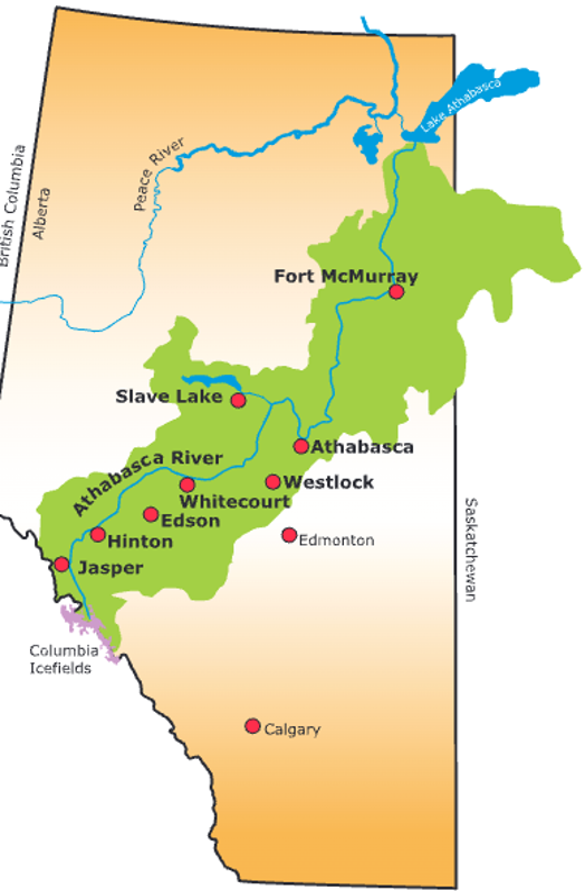
The Athabasca River (Athabasca) begins in the Columbia Icefield and runs north through Jasper, Hinton, Whitecourt, Athabasca and Fort McMurray before emptying into Lake Athabasca and the Peace-Athabasca Delta. It is the second largest river in Alberta; the basin itself covers 159,000 square kilometers, representing nearly one quarter of Alberta’s landmass (24%). At Fort McMurray, the river annually discharges over twenty billion cubic meters of water. This amount would fill Sylvan Lake over fifty times. The basin is an interconnected river system that includes the McLeod, Pembina, Lesser Slave and Clearwater Rivers, as well as extensive wetlands. It provides habitat for countless species. It is also the anchor of Alberta’s industrial heartland.
Figure 1: Map of Athabasca River Basin within Alberta
(Source: Jacobs, D (2007). Athabasca River Image Bank)
Reasons for the AER’s Decision
The AER rejected the request for regulatory appeal submitted by Ecojustice on behalf of the Athabasca and upheld the decision to approve the Jackpine mine renewals. They provided several reasons for the decision.
Firstly, the AER found that “the Athabasca is neither a natural person (a human), nor is it a legal person as that term is defined” (see here at 3). They acknowledged that there was no definition of “person” included within REDA and that section 28(1)(nn) of the Interpretation Act, RSA 2000, c I-8 requires an “inclusive rather than exclusive or prescriptive” definition of “person”, however they concluded that “inclusive wording does not confer upon the AER the liberty to prescribe any meaning it chooses” (at 3).
The AER rejected Ecojustice’s argument that recognizing the Athabasca’s personhood was “necessary to support the purposes of [the Environmental Protection and Enhancement Act] and the Water Act” (at 3). They asserted that the Alberta Legislature had not given the AER the authority to “endow a natural feature with legal personhood” as part of these Acts’ purpose to “protect the environment through public engagement” (at 3). The AER concluded that if the personhood of the Athabasca were recognized, then the correct representation for the Athabasca would be determined by the Crown because all surface and groundwater in the province is Crown property, and that Ecojustice would therefore have no authority to represent the Athabasca (at 4).
Finally, the AER determined that even if the Athabasca were to be considered a person for the purposes of submitting a regulatory appeal request, it would not be considered “directly and adversely affected” by the decision and would therefore be ineligible to make the request on that basis. They cited the test as requiring a person to demonstrate that a “potential or reasonable probability that he or she may be harmed by the approved project” exists, but found that the submission provided by Ecojustice regarding the environmental harms faced by the Athabasca as a result of the approval were “general and vague and not clearly linked to any actual and specific adverse effects of the Decision” (at 4). Furthermore, the impacts asserted by Ecojustice arise from the presence of the Jackpine Mine Project, and the AER has previously established “that renewal applications do not invite a full review of the project’s potential effects” (at 4). On these grounds, the AER dismissed the regulatory appeal request.
Not Full Personhood, but Procedural Standing
There is little Canadian precedent recognizing a natural feature as a “person” and in that sense the recognition of the Athabasca River as such would be precedent setting. While the AER is correct that recognizing the Athabasca River as a legal person would be novel, novelty is not the same as impossibility. Section 28(1) of the Interpretation Act, RSA 2000, c I-8 provides an inclusive, non-exhaustive definition of “person” that “includes a corporation and the heirs, executors, administrators or other legal representatives of a person.” This statutory definition should be interpreted as expanding the ordinary meaning of person, not as limiting it. An exhaustive definition would use wording such as “means” or “means only.” Further to that point, section 14 of REDA authorizes the AER to do all things necessary to carry out its mandate, and this arguably includes using its discretion to apply a broad definition of “person” when a narrow definition would prevent the fulfilment of its mandate.
The AER acknowledged that the statutory Interpretation Act definition of “person” was inclusive (at 3), but its reasons fail to apply the term as such and instead apply the narrowest available interpretation. The statute did not compel that narrowness. In fact, the opposite was the case, and that tension weakens the coherence of the AER’s reasoning. Refusal to recognize these living ecosystems is simply interpretive timidness. Canadian law already treats corporations and municipalities as “persons” with standing (see e.g. section 2(1) of the Canada Business Corporations Act, RSC 1985, c C-44). A broad interpretation of personhood ensures that a broad category of “persons” can provide necessary information which would otherwise be excluded from the decision making processes of courts and tribunals. This helps operationalize the principles of sustainability, integration and participation in Alberta’s decision-making bodies.
In this case, the AER framed the issues as if it were being asked to confer full legal personhood status on the Athabasca. It concluded that it lacked jurisdiction to expand the definition of “person” and that such authority rested solely with the legislature (at 3). However, the procedural type of legal personhood being asserted in this case differs significantly from the full legal personhood status for which the authority of the legislature is required.
Legal Personhood
In most other common law jurisdictions where legal personhood rights for natural features such as rivers and watersheds have been established, recognition typically arises through legislation that details the specific rights held by the natural feature and establishes a body responsible for representing its interests. One of the more well-known international examples of this approach is the Whanganui River in Aotearoa/New Zealand, which has its legal personhood recognized in Te Awa Tupua (Whanganui River Claims Settlement) Act 2017, 2017 No 7. This Act specifies the legal personhood status of the river as well as the M?ori and the Crown’s joint jurisdiction and responsibilities in regard to the river.
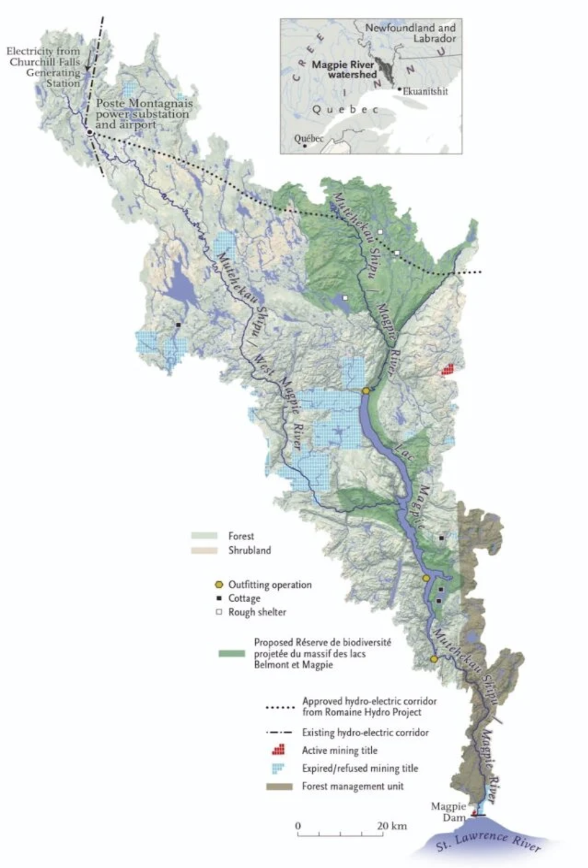
The best-known Canadian example is the Muteshekau-shipu or Magpie River in Quebec (Canadian Environmental Law Association, “Quebec’s Magpie River Is Now A Legal Person – A Monumental Moment in Canadian Environmental Law” (15 July 2021)). The Magpie River derives its personhood from sister resolutions passed by the Innu Council of Ekuanitshit (see here) and the municipality of Minganie (see here) which recognized the legal personhood of the river and nine specified rights (see Elizabeth Benner, “This pristine Canadian river has legal personhood, a new approach to conserving nature”, CBC (1 February 2024), and Eco Jurisprudence Monitor, Minganie (Canada) Municipal Resolution: rights of the Magpie River ).
Figure 2: Magpie River
(Source: Nature Canada)
In some jurisdictions, natural features have been granted legal personhood rights through judicial declarations rather than legislation. For example, in India, the High Court of Uttarakhand recognized legal personhood for natural features in Mohd. Salim v State of Uttarakhand, WPPIL 126/2014 and Lalit Miglani v State of Uttarakhand, WPPIL, 140/2015. In these cases, the court relied on the duties of the State and citizens to protect the environment as outlined in articles 48-A and 51-A(g) of the Constitution of India and the doctrine of parens patriae as the basis for their recognition. In Canada, there is no explicit constitutional duty of environmental protection, and there is minimal precedent for the application of parens patriae to environmental protection compared to other jurisdictions (British Columbia v Canadian Forest Products Ltd., 2004 SCC 38 (CanLII) at paras 69 and 78-80). Ultimately, Mohd. Salim v State of Uttarakhand was stayed by India’s Supreme Court. Moreover, the High Court’s decisions have been criticized for not clarifying the nature of the new rights and imposing new and unclear responsibilities on the government (see “India’s Ganges and Yamuna rivers are ‘not living entities’”, BBC (7 July 2017)).
Given that there was no pre-existing legislation or resolution asserting the legal personhood of the Athabasca River and detailing its rights, the statute-based type of legal personhood granted to the Whanganui was not applicable in this instance. Part of Ecojustice’s argument to the AER was based on the personhood status of the Magpie River (see here at para 16). They used this to demonstrate that precedent exists in Canadian law for the recognition of rivers as “persons”. One of the problems with this approach is that unlike the Athabasca, the Magpie River’s personhood was established by resolutions which included specific details regarding its rights and management. The AER was unwilling to declare recognition for the Athabasca’s personhood without legislative support and specifics as to what that recognition would mean (at 3). Much like the response to the High Court of Uttarakhand’s decisions, the AER was likely concerned about the unclear implications associated with recognizing the Athabasca as a legal person. However, the Athabasca was not seeking specific rights or protections beyond those already recognized in Canadian law. Rather than the rights-granting type of legal personhood, the AWA and the Keepers were arguing for the Athabasca’s procedural personhood, or in other words its ability to represent itself in the process that impacts its livelihood. While recognition of a natural feature as a person eligible to request regulatory appeal would also be precedent setting under Canadian law, other non-human entities or “persons” such as corporations and trusts presently enjoy such recognition.
The “Directly and Adversely Affected” Threshold
The AER’s decision turned on a narrow reading of “directly and adversely affected”. Under section 38 of the REDA, an eligible person may request a regulatory appeal. Section 36 defines an eligible person to include a person directly and adversely affected by a decision. The AER accepted CNUL’s position that the relevant harm had to be tied specifically to the renewal decision, instead of the Jackpine Mine’s ongoing operations (at 4). On that basis, it characterized the Athabasca River’s concerns surrounding water withdrawal, contaminants, wastewater, wetland destruction, leakage, and cumulative ecological effects as too general, too vague and too connected to the existing operation, rather than to the renewal application itself (at 4).
That approach is difficult to reconcile with Normtek (Normtek Radiation Services Ltd v Alberta Environmental Appeal Board, 2020 ABCA 456 (CanLII)). In that case, the Alberta Court of Appeal held that “directly affected” must be interpreted using the modern approach to statutory interpretation and read in light of the scheme and purposes of the legislation (Normtek at para 75). The Court accepted that the phrase “directly” limits who may appeal, but stressed that its general wording also leaves the tribunal broad discretion to determine who is directly affected in the circumstances of a particular case (at para. 77). It rejected per se rules and made clear that there is no single formula that can be mechanically applied across all of Alberta’s environmental approvals (at paras 78, 80, 88). It also held that “directly” requires a causal connection that is not remote or speculative, but not one so narrow that standing disappears whenever there are intermediate links between the approval and the harm (at paras 81, 99).
Applied to the Athabasca, the causal chain is not remote or speculative at all. The renewal approvals are the legal instruments that allow the Jackpine Mine to continue operating. If the mine cannot lawfully continue without those approvals, then the renewal decision is not meaningfully separate from the physical effects said to follow from continued operation. From the Athabasca’s perspective, these effects include ongoing water withdrawals from the river, contamination, wastewater impacts, leakage, and cumulative effects. The renewal is not an administrative formality sitting beside the harm, it is the legal authorization that permits the harm to continue. That is enough, at minimum, to support an arguable direct adverse effect under the broader, fact-specific approach endorsed in Normtek (at para 88).
Normtek’s reasoning also undercuts the AER’s attempt to separate standing from substance. The Court held that standing and merits are often intertwined, and that a tribunal acts unreasonably when it refuses to consider evidence relevant to standing simply because that same evidence also bears on the merits of the appeal (Normtek at paras 132 – 136). The Athabasca’s evidence about hydrology, contamination, water use, and cumulative effects was not collateral to the standing issue. It was the very material that was said to show how the renewal decision may directly harm the Basin. However, the AER dismisses these concerns as too general and too tied to the broader project, adopting the narrow and formalistic approach that Normtek rejected (see here at 4).
The threshold should not have been difficult to meet. Normtek’s reasoning says that all the Athabasca had to do was show a real and non-speculative possibility that the renewal would directly and adversely affect it. The Athabasca could indeed demonstrate such a possibility, given that the river is the ecological system receiving the withdrawals, discharges, and cumulative impacts of the Jackpine project. The river was not asserting a generalized public interest in environmental protection. It was asserting that the specific decision to renew the approvals would continue to alter the river system itself. That is precisely the kind of practical, fact-specific claim that should be heard and not screened out at the threshold.
Conclusion
Legal personhood for natural features in Canada continues to face real structural limits. Canadian courts have yet to recognize rivers or other natural features as legal persons in the way some foreign courts have, and there is no clear Canadian constitutional provision equivalent to the environmental duties relied on in jurisdictions such as New Zealand or India. The most durable path for full rights-of-nature regimes will likely be legislation that defines the rights of the natural feature, identifies its representatives, and sets out the remedies available when those rights are breached. Currently, no such legislation exists for the Athabasca.
However, the request made on behalf of the Athabasca did not require the AER to create a complete rights-of-nature regime. It required the AER to decide whether REDA’s existing standing provisions could be interpreted broadly enough to let a directly affected river basin be represented in a process authorizing continued industrial impacts. The answer did not need to settle the full legal status of the Athabasca River for all purposes. It only needed to determine whether the River could be heard in this regulatory proceeding.
By treating procedural standing as though it were full legal personhood, the AER misconstrued the issue and avoided the narrower question of whether the Athabasca should have standing. The result is a decision which preserves a rigid boundary between environmental harm and legal participation, and which allows for haphazard approvals of operations that withdraw from, discharge into, and cumulatively affect a river that the province of Alberta relies on. The Athabasca River was not asserting a generalized public interest in environmental protection. Rather, it argued that the decision to renew the Jackpine approvals would continue to alter the Basin itself. Such an assertion is the kind of direct, practical, and fact-specific claim Alberta’s environmental statutory bodies should be capable of hearing.
This post may be cited as: Hunter Folster & Shane Lethaby, “Standing in the Athabasca: AER Denies Nature Procedural Personhood in Alberta” (01 Jun 2026), online: ABlawg, http://ablawg.ca/wp-content/uploads/2026/06/Blog_HF_AthabascaStanding.pdf
To subscribe to ABlawg by email or RSS feed, please go to http://ablawg.ca
Follow us on Twitter @ABlawg