By: Kaitlin Schaaf, Kathy Cao, Jessica Farrell, Andrew Simmons, Emilia Yassiri, and Martin Olszynski
Matter Commented On: 1st International Colloquium on Closure Liabilities in the Energy Sector
PDF Version: The Mess We’re In: Insights from the 1st International Colloquium on Closure Liabilities in the Energy Sector
The 1st International Colloquium on Closure Liabilities in the Energy Sector was a recent three-day event organized by Professor Martin Olszynski, the current Chair in Energy, Resources and Sustainability, and hosted by the University of Calgary Faculty of Law with the support of the Public Interest Law Clinic (PILC) and the Canadian Institute for Resources Law (CIRL). From October 3 – October 5, 2025, the event brought together scholars and practitioners from Canada, the United States, Australia, and the United Kingdom to address the challenges associated with environmental liabilities in the energy sector.
The closure liability challenge has been subject to increased public and academic attention in recent years – and for good reason: the problem is unprecedented in its size and scope. Across jurisdictions, estimated liabilities range of in the tens to hundreds of billions of dollars, while only a small fraction of funds (i.e., financial assurance) has been set aside to fund future closure work (i.e., decommissioning, remediating and reclaiming).
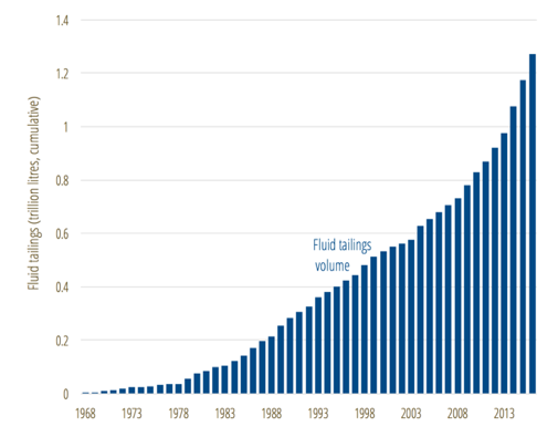
On top of these economic uncertainties, unaddressed closure obligations create great risks of harm to the environment and human health. In the United States, an estimated 3.9 million abandoned wells are leaking methane and toxins like arsenic into nearby ecosystems (see United States Environmental Protection Agency, Inventory of U.S. Greenhouse Gas Emissions and Sinks: 1990-2022 (EPA, 2024)). Meanwhile in Alberta, there is not only an inactive (not producing, but not decommissioned) and orphan well (no solvent owner) problem, but also an oil sands tailings ponds problem, in the form of over 1.4 trillion litres of toxic tailings currently stored in so-called tailings ponds (see Figure 1). These facts illustrate a common problem in extractive industries: the privatization of profits and the socialization of cleanup costs.
Figure 1: Fluid Tailing Ponds Volume Growth in Alberta since 1968
(Source: Pembina Institute, 2017)
The Colloquium aimed to build a foundation of international state-of-knowledge and current practice in the energy closure liability space. Papers were grouped into six different panels with three presentations per panels, grouped according to common subject matters. The first panel assessed national and subnational regimes for oil and gas closure, while the second panel presented new tools and perspectives on the same. The third panel focused on long term liabilities, especially those associated with the storage of nuclear waste and carbon dioxide in the context of carbon capture, utilization and storage (CCUS). The fourth panel explored closure liability issues in the renewable energy project context. The fifth panel presented a series of closure liability case studies. Finally, the sixth panel provided perspectives on the problem from practitioners in the oil and gas, energy, and mining fields.
The purpose of this blog is to provide a summary of each presentation and to highlight common themes that emerged over the course of the Colloquium. What we learned from attendees is that across jurisdictions and across sectors, woefully inadequate steps are being taken by regulators to strategically address obligations for the end-stage of projects’ lifecycle. However, there is some hope, as this Colloquium demonstrated that experts and academics around the world are acutely aware of, and are keen on tackling, the closure liability problem from diverse angles. The Colloquium was a unique opportunity for presenters to share insights and lessons learned across jurisdictions, and the sharing of such information is bound to be a vital step in the development of practical and effective solutions.
The discussions summarized in this paper reveal that despite differing contexts, jurisdictions face common challenges: weak regulatory regimes, inadequate financial safeguards, and a persistent tendency to treat environmental obligations as technical or administrative issues rather than matters of political and legal accountability. Taken together, the panels highlight the urgent need for more transparent, integrated, and democratic governance frameworks that embed closure and decommissioning responsibilities throughout the energy project lifecycle, ensuring that the costs of transition are not transferred onto the public or deferred to future generations.
Panel 1: Assessing National and Subnational Regimes for Oil and Gas Closure
The opening panel examined North American regulatory regimes governing oil and gas closure obligations. It brought together experts in law, policy, and environmental science to explore how democratic principles can guide reform.
First, Sarah Matsumoto, Associate Professor at Colorado Law (University of Colorado Boulder), outlined the current state of U.S. regulation governing closure liability, and especially federal legislation passed under the Biden Administration that provided funding for States to address their orphan well inventories. Professor Matsumoto explained how the Infrastructure Investment and Jobs Act, 23 USC § 101 (2021) and Inflation Reduction Act, 26 USC § 55 (2022) initially marked progress, funding orphan well cleanup and requiring methane tracking and groundwater testing. However, by 2024, concerns emerged that the federal framework ignored state-specific contexts. In response, or in any event, the new administration greatly cut funding and scaled back these initiatives.
Wyatt Sassman, Associate Professor at the University of Denver Sturm Law, zoomed in on Colorado, sharing insights into that states’ efforts since 2019, when then-new legislation was heralded as setting a new bar in terms of tackling the closure liability problem. Unfortunately, the results have been mixed, with weak enforcement and regulatory capture among the usual suspects. Consequently, Professor Sassman has proposed a new democratized model for closure governance. Current approaches to decommissioning in the energy sector suffer from a narrow focus on private liability, treating each site as an isolated financial and legal issue rather than as part of a broader transition challenge. A better model moving forward is democratic decommissioning, an approach that puts communities, workers, and local governments at the center of decision-making around energy site closures. This means using existing regulatory frameworks to support multi-scale planning that connects local, regional, and national priorities; and creating benefit-sharing mechanisms so that affected communities have a tangible stake in cleanup outcomes.
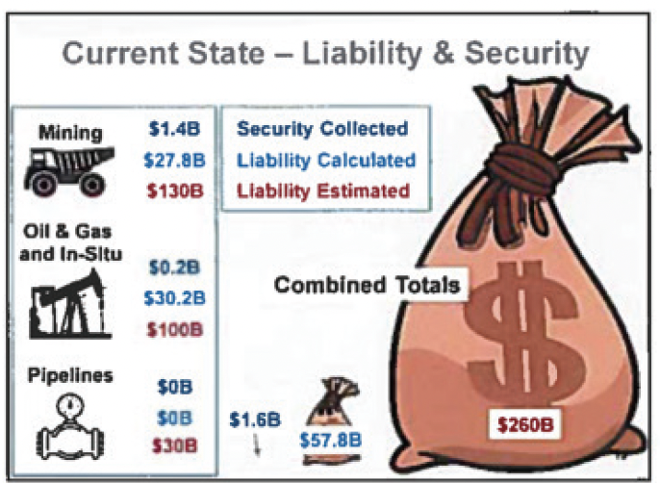
Finally, Professors Shaun Fluker and Martin Olszynski from the University of Calgary Faculty of Law presented the most recent results of their ongoing research into Alberta’s liability management framework (conducted together with Drew Yewchuk from Allard Hall, University of British Columbia). Professor Fluker explained how in 1997 Alberta established a relatively effective program to limit inactive well growth, the Long-Term Inactive Well Program (LTIWP), but abruptly repealed it in 2000 and replaced it with the ill-fated Licensee Liability Rating (LLR) system. The LLR eliminated financial safeguards and invited the deferral of closure work, causing Alberta’s inactive well inventory to surge throughout the 2000s and 2010s. In 2020, Alberta acknowledged that the existing approach under the LLR was “flawed” and introduced yet another system, the Liability Management Framework (LMF). Despite the LMF, enforcement remains minimal, and total oil and gas liabilities in the province have reached $320 billion (see Figure 2; adjusted for inflation, $260 billion in 2018 is $320 billion in 2025).
Figure 2: Estimated Oil and Gas Liability in Alberta, 2018. Adjusted for Inflation, Total is Now $320 Billion
(Source: Shaun Fluker, Martin Olszynski, and Drew Yewchuk’s Presentation, 2025)
Panel 2: New Tools and Perspectives on Oil and Gas Closure Obligations
The second group of panelists brought together three distinct perspectives on the issue of oil and gas closure obligations. We heard from Caylee Hong, Assistant Professor at the University of Alberta Faculty of Law, Martin Lockman, Assistant Professor at the William & Mary School of Law in Williamsburg, Virginia, and Anna Lund, Professor at the University of Alberta Faculty of Law. Each presenter had a unique take on how new tools, or even old tools used in new ways, could be used to address oil and gas closure obligations.
Professor Hong explored how new financial and environmental tools are enabling oil field decommissioning in the absence of strong regulatory regimes. Her research focused on the Los Cerritos Wetlands Oil Consolidation and Restoration Project in Los Angeles. The project creates two types of assets: oil revenues from limited continued production and mitigation credits earned through environmental restoration efforts that can be sold to developers and infrastructure companies seeking to offset their own ecological impacts. This model, though criticized for funding restoration through continued oil extraction, represents a pragmatic balance between ecological recovery and economic feasibility that can drive decommissioning in urban oil fields that would otherwise be abandoned.
Professor Lockman examined the “non-prosecution puzzle” of what he refers to as ‘environmental repair’ laws in the United States. Despite early 20th-century laws that make it a crime to fail to plug oil wells, criminal enforcement of these laws has virtually disappeared. Although the decline of enforcement partially stems from economic and political realities, regulators themselves reinforce the issue by permitting deferrals or allowing bankruptcies to wash away environmental liabilities in order to keep marginal operations alive. Thus, Professor Lockman proposed reframing environmental enforcement through the lens of fraud prosecution (i.e. targeting false or misleading statements made during operations), rather than post-hoc punishment for abandonment. This approach avoids “kicking a dead horse” by pursuing defunct companies and instead scrutinizes the truthfulness of ongoing disclosures and financial representations that misstate a company’s capacity or intent to fulfill its environmental repair duties.
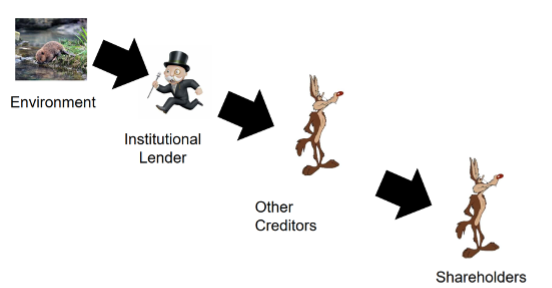
Professor Lund began by addressing a central problem in Canada’s insolvency framework: that companies can use insolvency proceedings to compromise or eliminate their environmental repair and decommissioning obligations. However, there are two mechanisms intended to prevent this abuse. First, under s 14.06(7) of the Bankruptcy and Insolvency Act, RSC 1985, c B-3, environmental remediation costs are given a super priority ranking, secured against the contaminated and contiguous lands, ranking above all other creditors (see Figure 3). However, she emphasized that this provision has limited practical effect because contaminated land often has little market value, and oil companies typically hold surface leases rather than ownership of the property itself. Second, following the landmark SCC Redwater decision (Orphan Well Association v Grant Thornton Ltd, 2019 SCC 5 (CanLII)) and the earlier Alberta case of Northern Badger (PanAmericana de Bienes y Servicios v Northern Badger Oil & Gas Limited, 1991 ABCA 181 (CanLII)), environmental obligations are not treated as provable claims because regulators are not creditors as they enforce a public duty rather than seek repayment. As a result, environmental cleanup orders survive bankruptcy and cannot be compromised like financial debts.
Figure 3: Super priority ranking of environmental remediation costs above all other creditors under the Bankruptcy and Insolvency Act
(Source: Anna Lund’s Presentation, 2025)
Finally, Professor Lund discussed the growing use of Reverse Vesting Orders (RVOs) in Canadian insolvency practice and the challenges they pose for environmental liability management. RVOs are court orders that allow a buyer to acquire a debtor company’s valuable assets while undesirable liabilities are “vested” into a separate residual company. Lund cautioned, that while courts have not yet used RVOs to eliminate environmental obligations, there is a real risk they could become tools for doing so. If RVOs allow environmental liabilities to be left behind in residual shells, the costs of remediation would inevitably fall to taxpayers. Thus, Canada’s courts and legislatures must develop clear principles and guardrails to prevent them from eroding the integrity of environmental law and public accountability.
Panel 3: Long Term Liabilities: Nuclear Waste and Carbon Capture and Storage
The third panel of the day brought together four speakers whose research examines how law, technology, and governance interact in managing long-term environmental liabilities for nuclear waste and carbon capture and storage (CCS).
First, Robin M. Rotman (Associate Professor) and Jhonathan Ordinola Diaz (PhD student) from the University of Missouri, opened with a review of the United States’ troubled history of nuclear waste management. Professor Rotman outlined how despite federal statutory commitments to take responsibility for spent nuclear fuel and how, that promise went unfulfilled. The resulting costs, exceeding $11 billion, now falls on taxpayers. To move forward, recent efforts have turned to “consent-based” siting, an approach that looks for volunteer host communities to store nuclear waste. Diaz shared the details of their ongoing Missouri case study, exploring how residents living near a commercial reactor perceive nuclear energy, waste storage, and federal oversight. Interestingly, initial findings have so far revealed both familiarity with, and lingering distrust of, government-led management.
Next, Scarlett Forrest, attorney and research scientist from the University of Wyoming, shifted the discussion to Wyoming’s regulatory model for CCS. CCS is viewed as essential to meeting climate goals, yet it is constrained by this fundamental question: who bears responsibility for stored carbon decades after injection? Wyoming’s framework provides an answer of sorts by requiring strict permitting and bonding before transferring primary liability to the state after twenty years of monitoring. Currently, the Dry Fork Station Project, designed to become the world’s largest membrane-based capture facility, stands as an example of the innovation and fragility of such a system in practice. While the current system requires financial assurance before releasing operators from liability, it may leave citizens unprotected in extreme cases such as private well contamination or catastrophic failure. Forrest suggests that Wyoming’s approach demonstrates how law can anticipate long-term risks but not eliminate them altogether.
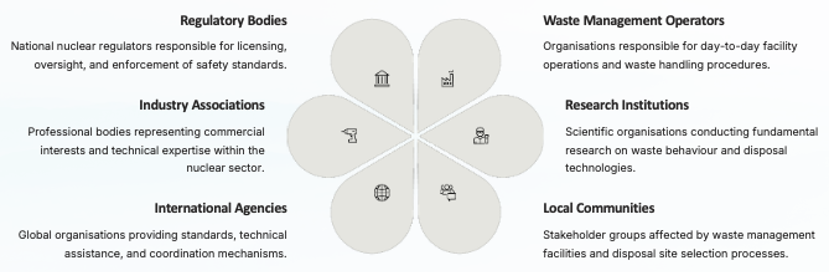
Lastly, Andrew G. Walters, PhD Candidate from the University of Aberdeen, concluded the panel by exploring whether digital platforms and algorithmic systems could one day replace traditional legal oversight in radioactive waste governance. Unlike established legal frameworks, “platform-based” models rely on continuous data, predictive modelling, and real-time monitoring. Digital systems, he argued, enhance precision and adapt more quickly. This is especially true in the complex stakeholder ecosystem that governs waste management (see Figure 4). However, these systems are far from replacing the stability and validity of legal authority, and the frequent need for human judgment still exist. Although digital systems can support coordination amongst actors in the complex stakeholder ecosystem, they cannot replace human deliberation and decision-making.
Figure 4: The Complex Stakeholder Ecosystem that Governs Waste Management
(Source: Andrew Walters’ Presentation, 2025)
Taken together, the speakers highlighted one recurring theme: the regulators’ temptation to treat governance problems as technical issues. Through consent-based siting, state responsibility transfer, and algorithmic regulation, these frameworks aim to manage risk: either by spreading it across time, institutions, or code. Yet, as each speaker noted, bearing environmental obligations is not just an engineering or administrative challenge. It is a test of political will and legal commitment, and without thorough consideration of attitudes, financial costs, and readiness to adapt, even the most advanced systems remain as band-aid solutions. Thus, they can still fail to address persistent problems of long-term liability.
Panel 4: Managing Closure Liabilities for Renewable Energy Projects
The fourth panel included presentations by Colin Mackie, Professor at University of Nottingham School of Law, Penelope Crossley, Professor at University of Sydney Law School, and Anna Mance, Assistant Professor at SMU Dedman School of Law. This panel on renewable energy projects underscored that while these projects are frequently portrayed as temporary or inherently “green”, the reality is that they face similar challenges to the fossil fuel industry: closure costs can be expensive, uncertain, and sometimes shifted to the public through weak financial guarantees and cursory legal consideration.
Professor Mackie and Professor Crossley’s presentations looked at specific types of renewable projects: wind and solar photovoltaics (PV). Professor Mackie’s presentation showed that bond provision for wind projects in England was relatively rare, often undervalued, and sometimes offset by uncertain salvage value. Professor Crossley’s presentation tackled the looming problem of solar PV waste, highlighting that recycling solar panels is six times more costly than sending them to the landfill, and that the panels will require vast amounts of critical minerals to reach net zero by 2040, which currently are not being recycled in a meaningful amount. Their studies call for stronger, more transparent regulatory frameworks that assign clear liability, require adequate financial security, and develop realistic cost estimates to ensure that end-of-life responsibilities are actually met rather than deferred.
Professor Mance’s work directly compared how decommissioning is addressed in legal challenges to fossil fuel projects versus renewable projects under NEPA (the US’s National Environmental Policy Act, 42 USC § 4321 (1969)) and found that while decommissioning in renewable projects is raised more frequently in legal cases compared to fossil fuel cases (27% vs 4.5%), they were cursory and not specifically challenging the decommissioning itself. Both sectors lack substantive legal engagement with end-of-life responsibilities.
Panel 5: Closure Liability Case Studies
The fifth panel of the day focused on real lessons learned from decommissioning case studies in the United States. First, Alaskan-based attorney, Catherine Rocchi, presented work that she had done together with Phil Wight, Professor at the University of Alaska Fairbanks. Their work examined the shortcomings of the regulatory regime that governs the safeguarding of funds for the decommissioning of the Trans-Alaska Pipeline System (TAPS). Lack of transparency and public accountability in the regime appears to provide great economic advantages to private companies that own TAPS at the expense of the state and Alaskan citizens. Furthermore, due to both system design flaws and weak regulatory oversight, it has incentivized the delay or avoidance of decommissioning obligation.
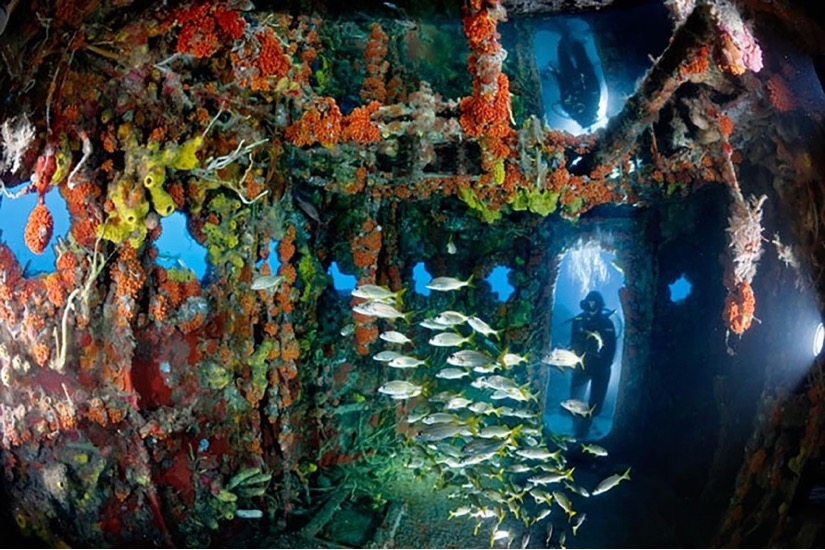
Robin Kundis Craig, Professor of Law at the University of Kansas Law School, presented the unexpected environmental and economic benefits arising from the decommissioning of offshore energy infrastructure. For onshore oil and gas wells, decommissioning tends to be thought of as habitat restoration and remediation. However, in the ocean, solid infrastructure, such as oil rigs, offshore wind turbines, and wave energy converters, actually becomes new habitat (see Figure 5). This has led to the development of American Gulf Rig to Reef Programs in the 1980s. These programs are governed by federal and state regulations and have been largely successful in the Gulf states, with marginal success in California. Lessons learned from oil rigs in the Gulf and California can be used to proactively address the “rig-to-reef” issue at the leasing and licensing stage for renewable infrastructure, such as offshore wind turbines and wave energy facilities.
Figure 5: A Decommissioned and “Reefed” Oil Rig Becomes New Aquatic Habitat
(Source: Joe Platko, New York Times, 2016)
Tracy Hester, Professor at the University of Houston Law Center, presented the idea of “energy escheat”, a new model for handling the reversionary interest of title in abandoned oil and gas wells. Common law escheat provides for the reversionary vesting of title to property in the state if an individual dies intestate and without heirs. In Professor Hester’s opinion, it is unlikely that common law escheat would directly apply to oil and gas, given the questionable economic value and massive liability of such properties. But there may be room for an extension of escheat law that is uniquely tailored to the oil and gas industry. Thereby, the tool of “energy escheat” could provide a new model for the management of oil and gas liabilities.
Panel 6: Practitioner Perspectives
The final panel brought together practicing lawyers, regulatory experts, and financial analysts to provide practical insights on the systematic failures that have plagued Canada’s energy and resource regulatory frameworks. Common among all presenters was the view that there are systemic root issues that have caused, or at the very least exacerbated, the closure liability problem in Canada.
Jessica Caradine, a senior analyst with Canadian non-profit, Investors for Paris Compliance (I4PC), presented research on oil and gas financial disclosures and the extent to which auditors play a role in ensuring oil and gas companies are adequately accounting for their environmental liabilities. Unsurprisingly, decommissioning liabilities were found to be severely under reported. Based on an independent estimate of industry liability, there is an approximately $113 billion gap between what is reported and what is owed. The inconsistent (and sometimes nonexistent) financial reporting of these companies creates uncertainty and is highly problematic for potential investors and other stakeholders.
Carla Conkin, a strategist, policy maker, and regulatory lawyer, and Jim Martin, a financial and economic analyst with a background in oil and gas, provided two distinct but synergistic perspectives. First, Conkin noted that in practice, government regulatory systems are “riders” on other dominating systems, such as corporate, market, and financial systems. However, if key system elements are demonstrably integrated, it is possible for regulatory systems to become a “driver” that stops exposure and ‘designed for failure’ factors while fostering environmental protection and advancing socio-economic benefits. In an integrated system, closure would not be looked at in isolation or as a linear piece that comes at the end of a project life cycle, but rather as an element that works in synchronicity with other variables throughout the project life cycle. The aim is to achieve healthy projects and healthy companies throughout the lifecycle.
Second, Martin highlighted that a necessary step in making the appropriate changes to our regulatory system is knowing the industry, enterprise, and project that is being regulated because different issues are faced when regulating the oil and gas industry as opposed to the renewables industry. While there are many externalities that can be attributed to oil and gas, he noted closure liabilities and greenhouse gas as “likely the worst”. Martin suggested the best approach to address these externalities and other issues would be to employ cross-jurisdictional cost-benefit analyses.
Nick Bryanskiy, a regulatory lawyer at P2 Regulatory Solutions, provided an overview of the regulatory framework governing power generation, transmission, and distribution in Alberta and highlighted a clear gap in the framework’s strategic planning for project end-of-life. Although the overall risk profile and liability exposure of power assets in Alberta is lower than that of oil and gas facilities or mines, there are still significant reclamation and remediation costs associated with power infrastructure. Despite these costs, only wind and power plants are required to provide upfront reclamation security (all other power plants are not subject to this statutory requirement). This end-of-life planning gap may be remedied by the prioritization of assets with higher environmental liabilities in terms of policy and enforcement, more communication and information-sharing among regulators, and active involvement of municipalities.
Conclusion
In sum, the panels revealed that closure liability, whether for oil and gas, nuclear waste, or renewables, remains a governance challenge across jurisdictions. Generally, regulatory capture, weak enforcement, and fragmented accountability have allowed environmental and financial risks to be deferred rather than resolved. Still, emerging reforms offer hope: democratized decision-making, stronger financial safeguards, innovative liability models, and greater transparency. Ultimately, any solution for the problem of environmental liabilities must integrate law, policy, finance, and community participation to ensure the costs of energy transitions are not unfairly borne by the public or future generations.
This post may be cited as: Kaitlin Schaaf, Kathy Cao, Jessica Farrell, Andrew Simmons, Emilia Yassiri, and Martin Olszynski, “The Mess We’re In: Insights from the 1st International Colloquium on Closure Liabilities in the Energy Sector” (21 November 2025), online: ABlawg, http://ablawg.ca/wp-content/uploads/2025/11/ Blog_KS,KC,JF,AS,EY,MO_IntColloquium.pdf
To subscribe to ABlawg by email or RSS feed, please go to http://ablawg.ca
Follow us on Twitter @ABlawg