By: Joe Sellman
Report Commented On: Alberta Law Reform Institute, Residential Tenancies: Distress for Rent Final Report 122 (pending publication)
PDF Version: Untangling Received Law in Alberta
What would you think if I told you that Alberta has inherited legislation from England that remains in effect today, and continues to impact the state of the law in this province?
As part of the Alberta Law Reform Institute’s (ALRI) Residential Tenancies Act project, we have been working on a standalone report considering whether the remedy of distress for rent should be abolished in residential tenancies, and if not abolished whether the law should be codified (see Issue 8 and Issue 9 in Alberta Law Reform Institute, Residential Tenancies Act: General Issues, Issue Paper 6 (2025) at 52-55).
Distress for rent is an ancient common law self-help remedy that, under certain conditions, allows a landlord to seize and sell a tenant’s property to recover unpaid rent. While there are many aspects of the English common law that still inform the law in Alberta, what makes distress for rent unusual is that it remains substantively unchanged since its reception in 1870.
In this blog post, we focus on sharing our experiences in untangling the hundreds of years of old English statutes that modified the common law of distress for rent to determine the current state of this remedy in Alberta.
Received Law: A Brief Background
Most introductory texts and introductory classes that provide a history of Canadian law include reference to received law. Many lawyers could then go their whole career without giving received law a second thought, unless they are confronted with a file where the Statute of Frauds (England), 1677, 29 Char II, c 3 is relevant. Perhaps unfortunately, there is significantly more received legislation from England that remains in effect (or potentially in effect) in Alberta.
In 1886, the federal government established that the reception date of applicable English law into the Northwest Territories was July 15, 1870 (North-West Territories Act amendment, (Canada), 1886, 49 Vict, c 25 s 3. Later, the Alberta Act (Canada), 1905, 4-5 Edw 7, c 3, s 16 incorporated the laws of the Northwest Territories into Alberta, including the received law of England as of July 15, 1870.
The applicability of received law can be, and has been, modified over time in Alberta (prior to 1905, the Northwest Territories), either by legislation or by the courts. The legislature can explicitly render elements of received law inapplicable through legislation which establishes that a received statute (or portions of the same) has no effect, or otherwise does not apply, in Alberta. Alternatively, the courts can determine whether a received statute (or a specific section of the statute) is applicable or inapplicable based on a range of considerations (including if the received legislation has been implicitly rendered inapplicable by more recent legislation).
In the 1960’s and 1970’s, Jean E Côté – who later sat on the Alberta Court of Appeal – was involved in a number of publications exploring the impact of received law in Alberta (see J.E Côté, “The Introduction of English Law into Alberta” (1964) 3:2 Alta L Rev 262, J.E Côté, “The Reception of English Law” (1977) 15:1 Alta L Rev 29). This culminated in a list of “English Statutes Probably In Force in Alberta” found in the 1975 ALRI paper, English Statutes in Force in Alberta.
However, since then, there has been little holistic academic review of the topic. Instead, contemporary references to received legislation are found scattered in the relevant case law or secondary sources.
The Research Challenge
While acknowledging the valuable work of Côté as a starting point for the research in determining the scope of distress for rent law received into Alberta, significant challenges remained.
The challenges that present themselves in any research into received legislation are:
- The general lack of awareness and lack of an authoritative list of English statutes that could still be in effect in Alberta;
- Interpreting the meaning and effect of older legislation (based on the archaic language and potentially significantly different legal context); and
- The time and effort it takes to:
- Determine which legislation was in effect in England at the date of reception;
- Find a copy of the historic legislation;
- Determine if the legislation was partially repealed before reception; and
- Determine if the legislation has been explicitly or implicitly rendered inapplicable or determined as inapplicable in Alberta.
Research Approach
Fortunately, technological advancements and online archives made this research much easier than it would have been even a few decades ago.
The Chronological Table (1869)
The “English Statutes Probably In Force in Alberta” relies on the Chronological Table of and Index to The Statutes to the End of the Session of 1869 (the Chronological Table). This document is only recently available digitally and online, with thanks to the University of Alberta Archives for digitizing this resource.
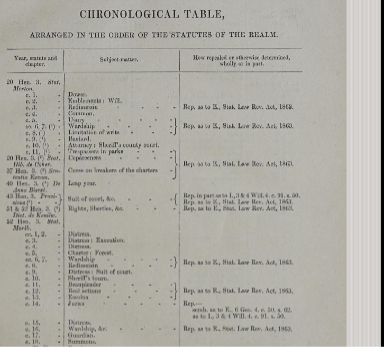
Considering the year of its creation, the Chronological Table is a remarkable document as it lists all English statutes chronologically indicating the topic of the legislation, and whether the legislation is in force, partially repealed, or fully repealed (including reference to the repealing legislation). For example, the earliest entries are from the reign of King Henry III (1216 to 1272):
While technology allows searching within the digitized Chronological Table (for example, you can search for the word “distress”), this is unnecessary as the second half of the document indexes statutes (that were still in force at the date of publication, i.e., in 1869) by topic.
Our first step was to therefore review the topic of “Distress” to determine potentially applicable received legislation:
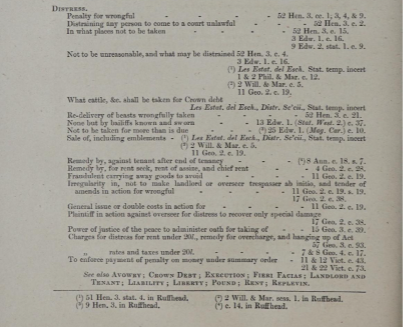
Additionally, we checked the cross-referenced topics, and then reviewed all these potentially applicable statutes against the chronological list to identify any relevant partial repeals.
Finding Digital Copies of Old English Statutes
Once we had the list of potentially applicable legislation, we were able to find and review the original legislation through the following excellent and freely available online resources:
We also note that the “List of English statutes” entry on Wikipedia is remarkably comprehensive, often providing valuable and informative initial research.
Bringing it all Together
Legal research is often better considered to be more of an art than a science. This was certainly the case researching the received legislation applicable to distress for rent in Alberta.
With the foundation of the received legislation research based on the Chronological Table, we continued to research the topic of distress for rent as we would for any project, including various secondary sources and relevant case law. As we worked through the various avenues of research, we kept note of all received legislation referenced in secondary sources and case law and then were able to check these against the Chronological Table.
Secondary sources and relevant case law can be essential in understanding the historic legal context of the legislation and the contemporary meaning of the legislation, especially for the older laws. For example, one of the oldest statutes considered in the research for distress for rent is the Statute of Marlborough (England), 1267, 52 Hen 3, of which chapter 4 is reproduced below:
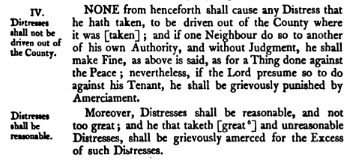
While the meaning of this legislation is not necessarily clear on its face, secondary sources helped us clarify that this chapter limits the distance property seized via distress for rent can be moved (to within the same county), made excessive distress unlawful, and is thought to give rise to the action for excessive distress.
Once we had our final list of potentially applicable received legislation, and generally understood its purpose, the final step was to search for any reference to the received legislation in case law or legislation from either the Northwest Territories (prior to 1905) or Alberta. In any references found, our goal was to identify whether the received legislation was explicitly rendered inapplicable (by legislation), explicitly determined as applicable or inapplicable by the courts, or potentially rendered implicitly inapplicable by contemporary legislation that legislates the same topic.
Concluding Remarks
We hope that sharing this post provides a useful reference for any other legal professionals or historians to consider when looking at the potentially applicable received legislation in Alberta.
Further, this research into received legislation that could apply to distress for rent in Alberta is part of our upcoming report on distress for rent in residential tenancies. Subscribe here to stay informed.
This post may be cited as: Joe Sellman, “Untangling Received Law in Alberta” (9 February 2026), online: ABlawg, http://ablawg.ca/wp-content/uploads/2026/02/ Blog_JS_DistressforRent.pdf
To subscribe to ABlawg by email or RSS feed, please go to http://ablawg.ca
Follow us on Twitter @ABlawg