By: Drew Yewchuk
Documents Commented On: Annual Mine Financial Security Program Submissions 2026 Submissions for 2025 Reporting Year; Mine Financial Security Program – Security and Liability, September 29, 2026.
This is the annual update following the posting of the submissions for the Mine Financial Security Program (MFSP) to the Alberta Energy Regulator (AER) website. See last year’s post here. The MFSP is Alberta’s troubled system for managing the financial security for the closure (decommissioning, remediation and reclamation) of oilsands and coal mines when they stop operating. For a detailed assessment of the weaknesses in the MFSP, see this 2023 paper coauthored with Martin Olszynski and Andrew Leach, “Not Fit for Purpose: Oil Sands Mines and Alberta’s Mine Financial Security Program”. In February 2025, the Alberta government made minor changes that did not address the fundamental problems with the MFSP – see our post here.
In brief, for the 2025-2026 year the MFSP collected additional security for a second year in a row after a ten-year period of collecting no security. A total of just over two billion dollars in security was collected from two oilsands mine operators for 2025-2026: Syncrude Canada Ltd. posted $1.5 billion due to the expected depletion of the reserves at Syncrude’s Mildred Lake-Aurora North mine (Mildred Lake-Aurora North). More troublingly, Fort Hills Energy Corporation (owned by Suncor) posted $0.5 billion for the Fort Hills mine (Fort Hills Mine) as a result of both triggering the “asset safety factor deposit” due to an asset-to-liability ratio below 3.00, and triggering payment of the “outstanding reclamation deposit” due to completing less reclamation area than planned. (MFSP Security and Liability, 2026 at 1) (these deposits are further explained below).
The security collection is a good thing. Anything is better than nothing, which is what the MFSP collected from 2015-2025, and $2 billion is significantly better than nothing. That said, there is still a gigantic gap between the security collected and total official estimated closure liability (and there are strong reasons to believe the regulator has kept the official estimate too low to downplay the scale of the problem). It is also concerning that the Fort Hills Mine triggered the asset safety factor deposit (ASFD) at this point in mine life.
Falling Asset Value Estimates and Rising Closure Liability Estimates
The total MFSP asset value, which is to say the estimated value of all proven and provable mining reserves, fell by 12% from $683 Billion in 2025 to $601 Billion in 2026. The total MFSP asset value was reported for the first time last year, so no long-term trend can be seen. The total estimated closure liability rose by $3 billion due to “surface reclamation, process-affected water treatment, and end-pit lakes costs.” (MFSP Security and Liability, 2026 at 1)
The Syncrude Mine’s Second Operating Life Deposit
As a quick refresher, the MFSP sets out four different types of deposits, which the AER summarizes as follows:
Base Security Deposit (BSD)
The approval holder pays the BSD once the AER allows the approval holder to use the four deposits to calculate their security. The BSD is used to maintain the security and safety of the site [i.e., it basically excludes closure work] until another operator assumes responsibility for the project or until all infrastructure is removed and the site is reclaimed.
Operating Life Deposit (OLD)
The OLD addresses project risks that coincide with the end of a mine’s reserves. An approval holder is required to start posting financial security when there are less than 15 years of reserves remaining. This deposit ensures that all outstanding abandonment, remediation, and surface reclamation costs will be fully secured by the time there are less than six years of reserves remaining.
Asset Safety Factor Deposit (ASFD)
The ASFD addresses the scenario where the approval holder’s MFSP asset value falls below three times [an arbitrary number] the cost of its MFSP liability. The ratio of MFSP assets to MFSP liability is called the asset safety factor (ASF). When a project’s MFSP asset-to-liability ratio falls below 3.0, the approval holder must pay financial security to set its ratio at 3.0.
Outstanding Reclamation Deposit (ORD)
The ORD addresses the risks posed by an approval holder that defers reclamation of its site until the end of operations. The approval holder must post an ORD when it fails to meet its approved reclamation plan targets [which it sets for itself in the first instance].
Note that the ORD and OLD are distinct types of security, despite the unfortunately similar acronyms. As noted above, the OLD is intended to ensure that full security for mine closure is in place six years before a mine’s reserves are depleted. It accomplishes this by raising the required security by 10% of the mine’s estimated closure liability each year starting when the mine has 15 years of estimated reserves remaining.
Thus far, OLD security has only ever been posted for Syncrude’s Mildred Lake-Aurora North mine. Last year (2025), Syncrude posted $868,626,731.00 to the OLD, bringing their total security to $1,073,929,755.00 (this is the sum of Syncrude’s base security deposit (BSD) and first OLD payment). The MFSP considers the Mildred Lake-Aurora North mine to have 14 years of reserves remaining.
Pursuant to the MFSP Standard, the ordinary operation of the MFSP would have seen Syncrude post an annual deposit of the same size, 10% of total the mine’s MFSP liability ($1,073,929,755.00), for the next 10 years. But that is not what happened. Syncrude instead posted more ($1,583,091,703.00), bringing their total security up to $2,657,021,458.00. Syncrude’s higher than expected payment suggests the MFSP liability was re-estimated at $13.28 billion, up from a $10.7 billion estimate in 2025 (based on that initial OLD deposit). A one-year change of $2.5 billion in estimated liability for a single mine, or 18%, reinforces prior concerns that there is major uncertainty in liability calculation. As we described in the 2023 paper, the liability estimate system is opaque and its numbers, which are not independently verified, have been jumping around by billions of dollars a year since 2023.
The simple method of calculating OLD security makes the calculation of the mine’s total liability easy (see AER Manual 024 at 21). Since $2,657,021,458 is two years of OLD payments totaling 20% of the mine’s estimated liability, you only need to multiply by 5 to get the MFSP’s estimated liability for the Mildred Lake-Aurora North mine: $13.28 billion.
No other oilsands mine have posted security OLD security. It is likely that Suncor’s Base mine will begin making OLD payments soon, but the MFSP information is not sufficient to know when. No other mine is likely to start making OLD payments until at least 2037.
The Fort Hill’s Mine Asset Safety Factor Deposit and Outstanding Reclamation Deposit
The Fort Hills Mine posted $517,300,271.00 under two different types of MFSP security: the ORD and the ASFD. The MFSP documents do not show how much the Fort Hills Mine paid under each deposit, but it is possible to estimate based on available information.
The ORD is intended to collect security where operators do not meet their scheduled progressive reclamation plans, which the operators themselves set. To our knowledge, this is the first time an ORD has been required from any oilsands mine. We cannot calculate how much Fort Hills Mine paid under the ORD because operators can carry forwards reclamation credits from past years but the credits carried forward are not reported to the public (MFSP Standard, s 6). However, the ORD was likely less than $300,000 (a tiny fraction of the total posted security) because Fort Hills Mine was 3.2 hectares behind their schedule (based on its own submission) and there is no evidence the AER has raised the deposit requirement above $75,000/hectare (although the AER did commit to reviewing this number, which has not changed since 2011, during the 2022 MFSP Review).
It is therefore likely that the bulk of the security paid for the Fort Hills Mine (around $517 million) was under the ASFD. The ASFD is an asset-to-liability system built on the same principles as the infamously catastrophic licensee liability rating system formerly used in Alberta’s conventional oil and gas fields. As noted above, the ASFD is triggered when the ratio between the estimated value of the mine’s remaining reserves (proven and provable) and the mine’s estimated closure liability drops below 3.0. Table 1 shows the Fort Hills Mine asset safety Factor ratio since 2016.
Table 1: Fort Hills Mine Asset Safety Factor, 2016-2026
| 2016 | 2017 | 2018 | 2019 | 2020 | 2021 | 2022 | 2023 | 2024 | 2025 | 2026 |
| 9.00 | 4.50 | 7.32 | 3.91 | 4.6 | 3.77 | 3.03 | 5.45 | 3.22 | 3.68 | 2.86 |
Table 1 shows the volatility problem with asset-to-liability ratio systems. The ratio has changed by at least 0.45 every single year, it decreased in 6 of the years and increased in 4 of the years, and it once dropped by half (2016 to 2017). The volatility occurs when both assets and liability estimates change in opposite directions in the same year. This volatility means that next year the Fort Hills Mine may have all ASFD security returned or could be required to post more than $7 billion (if the Fort Hills Mine ASFD drops as it did in 2018-2019 or 2023-2024). A well-designed system for financial security should avoid making sudden large calls for security since it can cause cashflow problems, risk forcing an insolvency, or fail to collect the security and leave the public holding an unsecured closure liability.
For the total liability of the Fort Hills Mine, since the ASFD shortfall of 0.14 required a security deposit around $517 million, then the MFSP’s estimated liability of the Fort Hills Mine is around $3.5 billion. This appears low compared to the Mildred Lake-Aurora North mine liability (about 25%) but may make sense when one considers that Mildred Lake-Aurora North includes two sites, a processing plant, upgrader, and four above ground tailings facilities, whereas Fort Hills Mine is just one site with no large processing plant facility and only one above ground tailings facility.
In any event, dropping below the 3.0 ratio is suggestive of a problem, bearing in mind also that there are strong reasons to suspect the MFSP is underestimating closure liability and overestimating reserve value, exactly as happened with the conventional field’s previous licensee liability rating (LLR). The other concerning detail is that the Fort Hills Mine has started posting security under the ASFD before paying anything under OLD, meaning the profitability of the Fort Hills Mine is within the range considered financially troubled by the MFSP, but the mine is also expected to be operating for more than 16 years. Something is wrong at the Fort Hills Mine or very wrong with the MFSP’s calculations. Or both.
The Total MFSP Asset Value
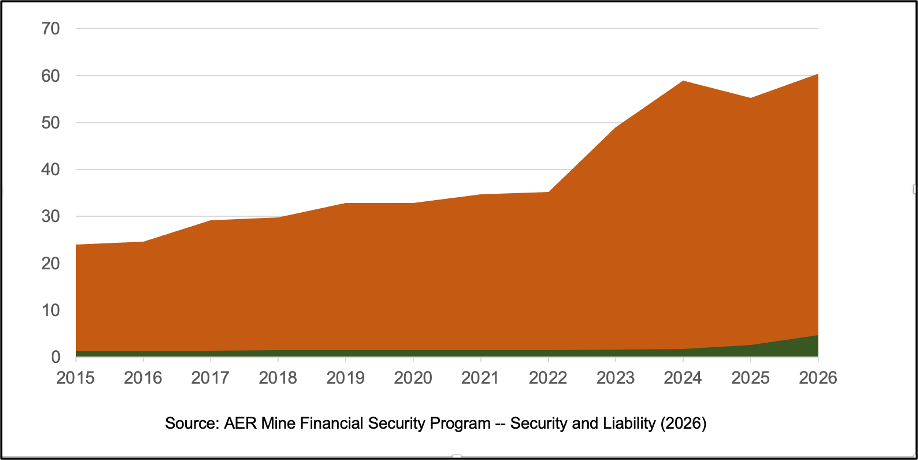
On September 29, 2026, the MFSP held $4.7 billion in security against an officially estimated $55.7 billion in liability (see Figure 1).
Figure 1: Mine Financial Security Program (MFSP)
Liability (Orange) and Security (Green)
The swings in estimated MFSP liability (Figure 2, below) show there is a problem with the MFSP’s secretive method for estimating mine liability. This problem becomes more important each year, as oilsands mines age and encounter financial difficulties.
Figure 2: Aggregate CEO/CFO Certified MFSP Liability
2022/23/24/25/26 ($CAN billions)
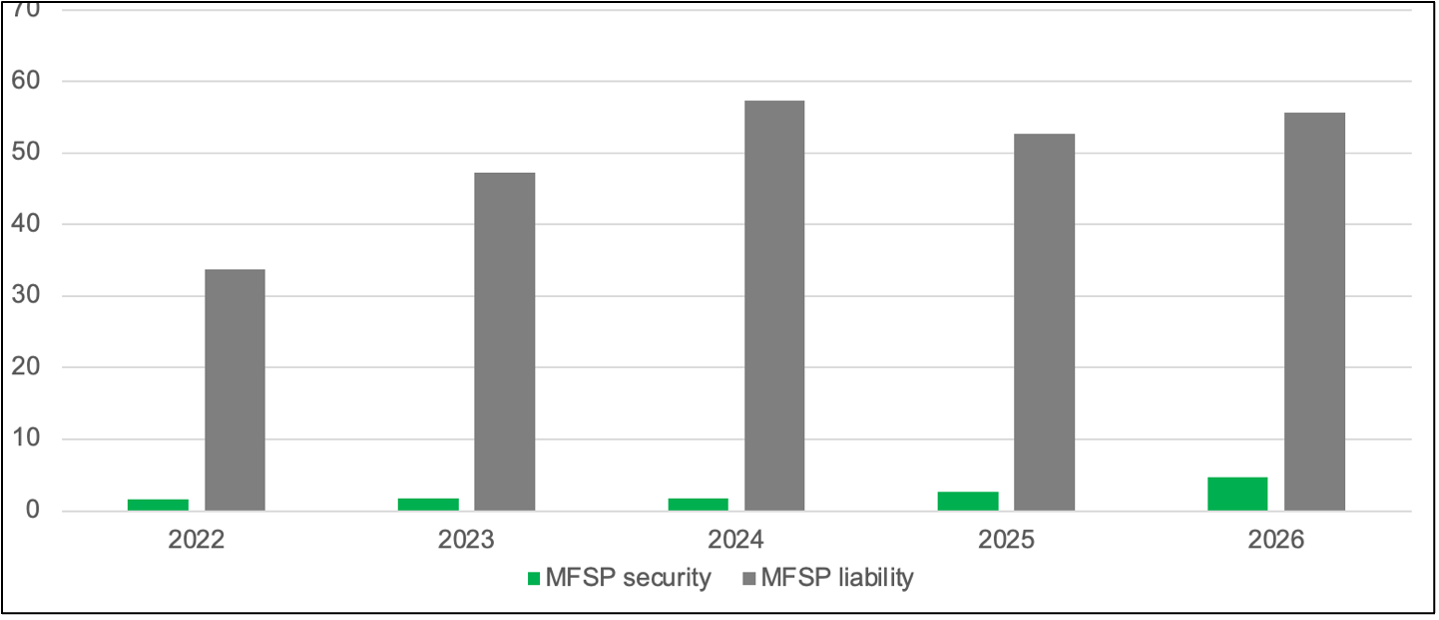
Source: AER Mine Financial Security Program – Security and Liability (2026)
Coal Mines
The MFSP security for coal mine closure increased by $11,518,787.00, collected from five mines, including a first deposit from Summit Coal Inc.’s Mine 14 Project. $653,464 was also returned to WestMet Group Canada Ltd for completed reclamation at the Sheerness & Montgomery mines.
The AER’s Unsystematic Policy for MFSP Information
An odd feature of the MFSP since 2025 is that it makes some information about the closure liabilities of specific mines easily calculable by the public once the MFSP begins collecting security. The public now knows the Mildred Lake-Aurora North mine’s MFSP’s closure liability ($13.28 billion) and that it currently has an expected 13 years of reserves. The public can also estimate the MFSP’s closure liability for the Fort Hills Mine ($3.5 billion). But the public receives no information on the estimated closure liability for the other mines and must perform an unreliable easter egg hunt through old regulatory documents to get an idea when each mine is expected to use up their reserves (See table 1 in the 2025 MFSP post).
The best explanation of the partial information publicity of the MFSP is that the designers of the MFSP forgot that once security started to be posted, the public could find mine-specific figures using simple multiplication. There is a total lack of rationality to this – the AER may be keeping information related to the MFSP secret to decrease scrutiny by the public, or simply as a relic of Canada’s tradition of administrative secrecy. Syncrude’s information is now public and the information of other operators is not, and this does not seem to be harming Syncrude. This provides strong evidence the AER could make more information from the MFSP program public without causing any problems to mine operators (specifically, the liability estimates for each mine and each mines’ expected schedule for OLD payments). As it stands, the public has enough information to know something is wrong, but not quite enough information to identify precisely what.
Conclusion
The continued collection of OLD security for the Mildred Lake-Aurora North mine is good. The rest of the information in this year’s annual MFSP report trends towards bad. The ASFD appears broken, and there is a problem between the MFSP and the Fort Hills Mine. There is virtually no likelihood of reform or improvement to the MFSP in the next year, so the issue to watch will be what happens with the Fort Hills Mine until the next MFSP data is released in September 2027.
This post may be cited as: Drew Yewchuk, “The 2026 Mine Financial Security Program Update: More Volatility in Liability Estimates and an Asset-to-Liability Problem with the Fort Hills Mine” (23 October 2026), online: ABlawg, http://ablawg.ca/wp-content/uploads/2026/10/Blog_DY_MFSP_2026.pdf
To subscribe to ABlawg by email or RSS feed, please go to http://ablawg.ca
Follow us on Twitter @ABlawg