By: Drew Yewchuk & Shaun Fluker
Regulatory Bulletin Commented On: Alberta Energy Regulator, Bulletin 2025-32, Invitation for Feedback on Proposed Revisions to Closure Nomination Requirements in Directive 088
PDF Version: A Review of Closure Nomination for Inactive Oil and Gas Sites and AER Updates to Directive 088
The Alberta Energy Regulator (AER) is taking comments on some proposed changes to the process for nominating oil and gas sites (facilities and wells) for closure work. The comment period is open until November 12, 2025. The AER’s closure nomination system has been in place since April 2023, and one of us commented on its commencement in Updates to the Oil and Gas Liability Management Framework: The New Closure Nomination and The Renamed Closure Quotas. The proposed changes adjust the timelines for the closure nomination. In particular, they shorten the timeline for nominated sites that had already been decommissioned to complete a phase 1 environmental site assessment from three years to one year, and they extend all closure nomination timelines to the end of the quarter-year. This post reviews the public information on the closure nomination process so far, discusses the AER’s proposed changes, and assesses the effectiveness of the closure nomination process so far.
The Closure Nomination Process
The closure nomination program is implemented with the AER’s power under section 3.016 of the Oil and Gas Conservation Rules, Alta Reg 151/1971. Section 3.016 was added to the Rules as part of the Alberta government’s implementation of the Liability Management Framework, initially announced in July 2020. Section 3.016 entitles an “eligible requestor” to require that a closure plan be prepared by a licensee for an “eligible well or facility site”. Section 3.016 prescribes that an “eligible requestor” can be a landowner, a First Nation, or a Metis Settlement. For wells and facilities on public lands, either the Minister or a municipality is the eligible requestor. An “eligible well or facility site” is one which has been inactive or decommissioned (aka abandoned) for five years or more (including where decommissioning was done but reclamation has not been done).
The nomination process, timelines, and closure plan development requirements are set out in section 4.2 of the AER Manual 023 – Licensee Life-Cycle Management . The process in Manual 023 has essentially three steps: (1) the submission of an application for closure nomination; (2) a eligibility determination by the AER that the submission is made by an “eligible requestor” for an “eligible well or facility site”; and (3) if the AER determines the eligibility requirements are met, the submission by the licensee of a closure plan that meets the prescribed requirements. The AER describes the closure nomination program on its website here.
The AER makes a discretionary decision in the closure nomination process with very little transparency. The AER may allow the licensee to develop a “non-baseline” closure plan or defer closure work entirely. Manual 023 allows a licensee to select between “baseline”, “non-baseline”, or deferral. A baseline closure plan is the default, and provides for a closure schedule (environmental site assessment, remediation and reclamation work, and certification of closure) of between 10-13 years. A non-baseline closure plan is intended for complexities or unique challenges associated with closure of a site, and involves longer timeframes than a baseline plan. The AER approves the terms and conditions of a non-baseline closure plan. Manual 023 does not provide any information on what, if any, participatory entitlements a landowner or the public (in the case of public land) may exercise to contest a decision by a licensee to pursue a non-baseline closure plan or more problematically, a request to defer closure work entirely. Manual 023 indicates the AER has full discretion to approve or reject this request by a licensee based on some prescribed considerations with no mention of procedure.
The initial closure nomination process in Alberta was administered with federal funding from the Site Rehabilitation Program that ran from April 2020 to February 2023. The system for applications for federal funding in the site nomination process was reworked to become the AER’s closure nomination system, with some nominations transferred from one system to the other. So, although the closure nomination system proper took effect in April 2023, the system includes sites nominated as early as May 2020. This complicates an assessment of the operation of the site nomination process, as data from the early years combines the outcomes of two different nomination systems.
The AER maintains a closure nomination dashboard that discloses the status of accepted closure nominations and makes some data on the accepted closure nomination process available to the public (although some information requires a user to download and process the data using a spreadsheet program). As of October 15, 2025, the dashboard shows a total of 1,436 sites accepted under the closure nomination system, and filters allow us to glean some insightful information on the operation of the closure nomination program to date.
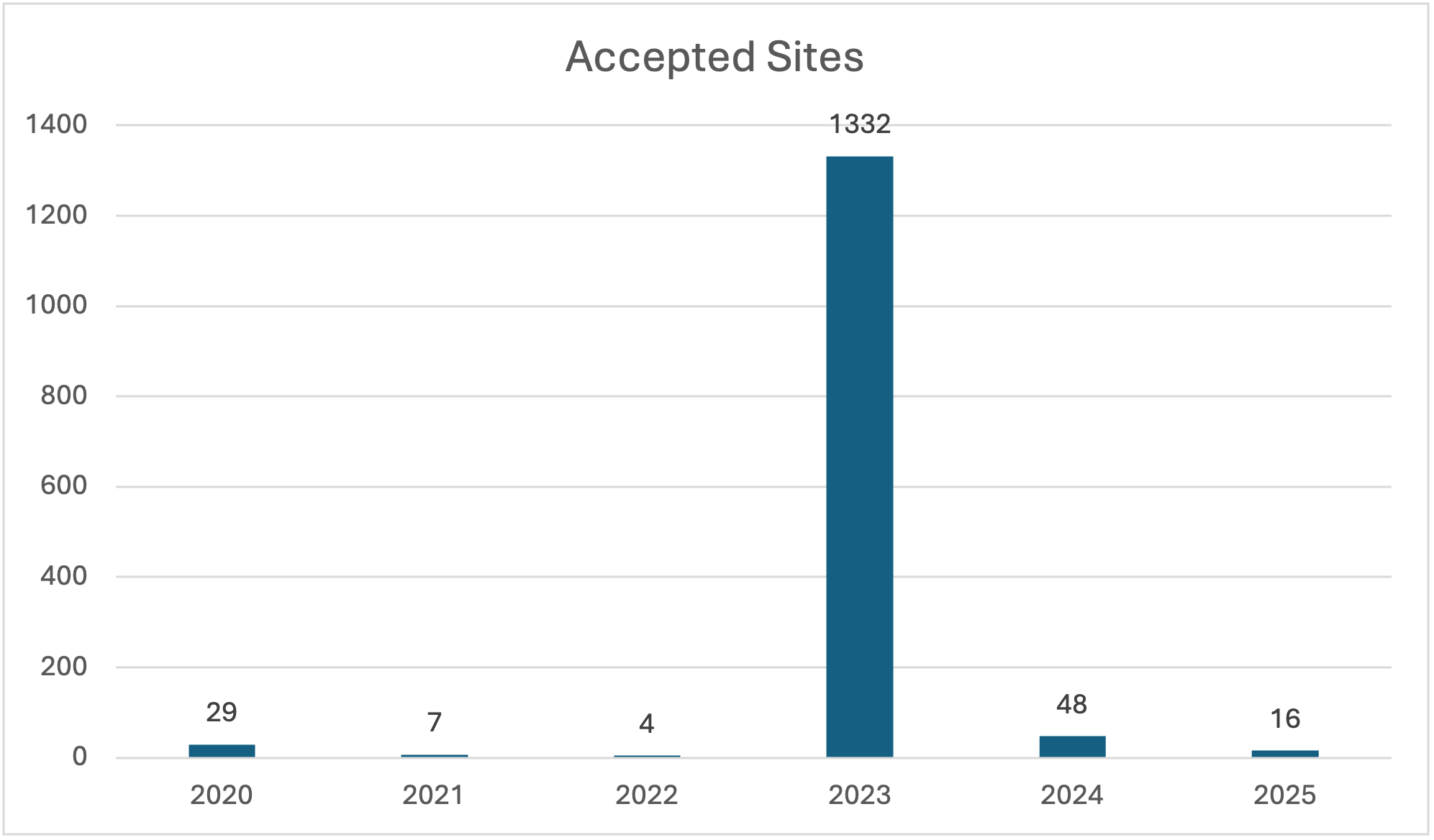
There are 40 sites nominated from 2020-2022 (under the previous Site Rehabilitation Program, described above). Almost all the accepted sites currently in the closure nomination program were accepted in 2023, when the AER program was launched. Does this mean that closure nomination applications flooded the AER at the outset of the program, and then reduced to a trickle thereafter? Or alternatively, do these numbers indicate that the AER initially accepted closure nomination applications from landowners and has since largely declined them in 2024 and 2025? The program offers no transparency on this because the AER does not disclose information on rejected applications.
Most accepted sites have been nominated by a landowner: 1032. Followed by 293 nominations from a First Nation, 103 nominations from a Metis Settlement, and 8 nominations from a Disposition Holder (e.g. the holder of a grazing lease). By site type, the accepted sites for closure work are nearly all well sites. The dashboard shows 1380 well sites, 52 facilities, and 4 “open clearings”. The dashboard does not explain what it means by an “open clearing” – perhaps sites cleared for drilling but where no drilling took place.
There are three licensees with more than 50 closure nominated sites: Alphabow Energy Ltd. with 453, Battle River Energy Ltd. with 205; and Canadian Natural Resources Ltd. with 87. Alphabow Energy Ltd. accounts for almost a third of the closure nominated sites, yet those sites are stuck in limbo as Alphabow is undergoing a restructuring under the Companies’ Creditors Arrangement Act, RSC 1985, c C-36. See Drew Yewchuk’s 2022 blog for the story of AlphaBow Energy Ltd.
By location, a notable outlier is Flagstaff County, with the most closure nominated sites at 236 sites. This outlier is because of the situation with Alphabow Energy Ltd., as 211 of the closure nominated sites in Flagstaff County are held by Alphabow Energy Ltd.
The AER’s Proposed Changes to Directive 088 and the Closure Nomination System
There are largely organizational changes for section 4.2 of Directive 088. The proposal slightly reorganizes the section so that it begins with a concise description of the three step process described above for a closure nomination: (1) the submission of an application for closure nomination; (2) an eligibility determination by the AER that the submission is made by an “eligible requestor” for an “eligible well or facility site”; and (3) the licensee selection on closure (baseline or non-baseline or deferral). The proposal includes an administrative change that rounds up each timeline on closure work to the end of each quarter (all deadlines in January to March are extended to March 31; all deadlines in April to June are extended to June 30, etc.). These extensions are significant (a month or two in many cases), but not large enough to change the overall function closure nomination process, and the purpose appears to be simplifying the administration of the closure nomination process instead of weakening regulatory obligations. The proposed changes also more clearly set out the timelines for closure work in a baseline closure plan. The timeline set out in section 4.2 would now separate sites that had been decommissioned (had “abandoned” status) at the time of nomination from sites that had not been decommissioned. Under the current Directive 088, sites that have already been abandoned received a needlessly long time (3 years) to complete a Phase 1 environmental site assessment. The proposed changes offer nothing new in terms of transparency into the decision-making process by the AER in exercising its discretion under this program.
Conclusion
The closure nomination program is a welcome and important component of the Liability Management Framework, and opportunity to nominate sites helps to ensure closure work is both responsive and accountable to the surface landowners adversely affected by oil and gas sites which industry has either neglected to clean up or left for others to do so. Since closure work can take 10 years or longer to be completed and reclamation certified, the effectiveness of the closure nomination program cannot be assessed until 10 years after initial nomination. For the large bulk of current sites in the program, that means 2033 or later before the results will be in.
Like the rest of the AER’s implementation of the Liability Management Framework, the closure nomination program is marred by poor transparency and excessive discretion (as we (along with Martin Olszynski) have noted several times – see e.g. Grading the 2023 AER Liability Management Performance Report and A Made-in-Alberta Failure: Unfunded Oil and Gas Closure Liability). The proposed changes do nothing to change this. The fact that very few additional sites have been accepted for closure in 2024 and 2025 is either because landowners are not nominating new sites for closure, or the AER has started to deny closure nominations. A lack of public information makes it impossible to know the reason for sure, but also fuels speculation that the AER is denying applications because industry would prefer to continue kicking the clean-up can down the road. We will pursue further information on the closure nomination system through access to information.
The effectiveness of the closure nomination program is severely limited by the narrow requirements for sites to be eligible. Marginal sites, orphan sites, and sites inactive less than five years are ineligible. There are more than 97,000 marginal wells in Alberta (wells producing less than 10 barrels of oil equivalent (BOE) per day on average). Those wells are a nuisance that bring licensees into conflict with surface rights owners and municipalities. Closure nomination also fails where a licensee enters an insolvency or bankruptcy process (as is occurring with Alphabow). Licensees with large volumes of nominated sites will tend to have financial difficulties and, if the licensee enters bankruptcy, closure work typically slows or stops. The new section 4.2.2 in proposed Directive 088 restates what is in the current Directive: the closure plan and its obligations move with the asset when it is transferred to a new licensee. But it does not appear the timelines for nominated sites apply to the Orphan Well Association (OWA). If previously nominated sites are transferred to the Orphan Well Association nothing ensures the sites are closed within a reasonable time. This problem is really just an aspect of the problem discussed in past posts: the OWA’s timelines for closing their inventory are excessively long, already dragging out to somewhere between 2037 and 2040 and at risk of being pushed further out. One might reasonably expect, for example, that Directive 088 might say something specific about this problem.
1,400 sites across three years is a drop in the bucket for Alberta’s inactive and marginal oil and gas site problem. The closure nomination program provides a tool for the prioritization of particular sites, but does not seem like it will significantly assist with the pace at which closure work is done. If the AER wants to strengthen the closure nomination program, they will need to expand the eligibility criteria. Overall, the mandatory closure spend will be far more important in determining the rate at which the inactive oil and gas site problem is addressed.
It remains to be seen whether the closure nomination program survives the implementation of the Mature Asset Strategy. Strangely, while the Strategy emphasizes the need to repair broken trust between industry and landowners it makes no reference whatsoever to the utility of the closure nomination program in helping to achieve that objective.
This post may be cited as: Drew Yewchuk & Shaun Fluker, “A Review of Closure Nomination for Inactive Oil and Gas Sites and AER Updates to Directive 088” (24 October 2025), online: ABlawg, http://ablawg.ca/wp-content/uploads/2025/10/ Blog_DY&SF_Dir088.pdf
To subscribe to ABlawg by email or RSS feed, please go to http://ablawg.ca
Follow us on Twitter @ABlawg